
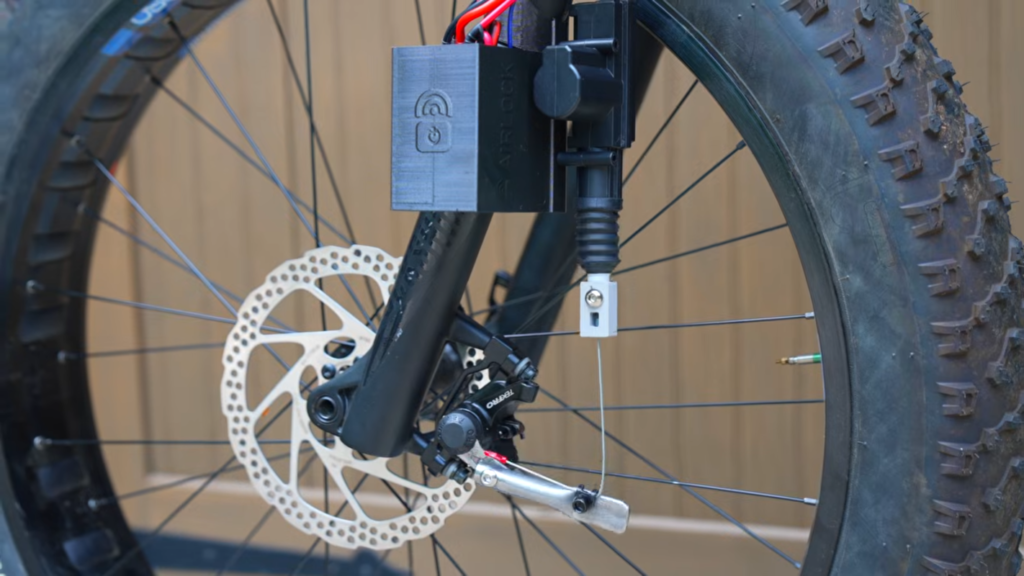
Cutting the cable on a bicycle brake sounds like a bad idea until you see what the ESP32 does with the freedom. Berm Peak strapped a radio link between the levers and the calipers of a fat-tire bike, and the result is a brake that can do anti-lock, adjustable bite point, and a parent-controlled speed limiter on a kid’s bike across the trail.
The mechanical trick is that the calipers are pulled by 12 V car door lock actuators instead of a hydraulic line. Those actuators are cheap, punchy, and completely wrong for the job out of the box, so the build went through several prototype rounds: better calipers, a steeper actuator mounting angle, and longer lever arms to trade the actuator’s short throw for usable clamping force. The stock caliper return springs stayed in place and do the releasing.
What the radio link actually does
Each lever, each caliper, and the handlebar display runs its own ESP32, all talking on 2.4 GHz. ESP-NOW is the sensible protocol here because it skips the Wi-Fi association handshake entirely and pushes a payload of up to 250 bytes straight to a peer MAC address, with round trips in the low single-digit milliseconds. That latency budget is what makes ABS possible: read wheel speed, notice lockup, pulse the actuator, repeat.
Two gotchas will bite you here. The ESP32 runs 3.3 V logic and the actuators want 12 V at a few amps, so an H-bridge or a MOSFET driver sits between them, never a bare GPIO pin. And a brake that fails silent is not a brake, so the caliper node needs a watchdog: if no packet arrives within a set window, clamp by default rather than coast.
Build a safer version on the bench
Do not put your first attempt on a bike. Wire two ESP32 dev boards on a breadboard, put a pull-up on the lever switch, and drive a 5 V linear actuator or a hobby servo as a stand-in load while you tune the mapping curve. The espressif ESP-NOW library ships with the Arduino core, so a working transmitter sketch is about thirty lines. Add a hall sensor and a magnet on the wheel to get the RPM signal your ABS loop needs.
An ESP32 dev board runs around PHP 350 at circuit.rocks, and a hall sensor module is under PHP 100, so a bench rig costs less than a single hydraulic brake bleed kit. Watch the full build at Hackaday’s writeup, then start with the watchdog before you touch the actuator code.
Frequently Asked Questions
How do the brakes actually clamp without a hydraulic line?
Twelve-volt car door lock actuators pull the calipers, and the stock caliper return springs handle the release. Getting usable force meant swapping in better calipers, steepening the actuator mounting angle, and lengthening the lever arms.
Why ESP-NOW instead of regular Wi-Fi or Bluetooth?
ESP-NOW skips the Wi-Fi association handshake and sends up to 250 bytes directly to a peer MAC address, with round trips in the low single-digit milliseconds. That latency budget is what lets the controller detect wheel lockup and pulse the actuator fast enough for ABS.
What will I learn if I build this?
You get hands-on practice with peer-to-peer ESP32 radio, H-bridge and MOSFET driving of a 12 V load from 3.3 V logic, hall-sensor RPM measurement, and closed-loop control with a watchdog fail-safe. Those are the same building blocks behind motor control and telemetry sections of most ECE thesis and robotics competition projects.
