
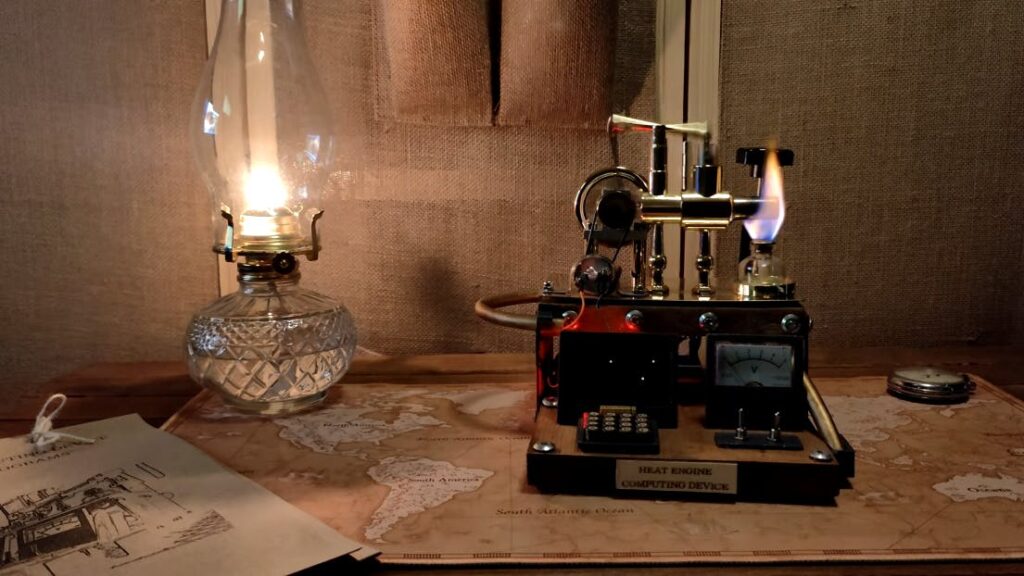
Power is the quiet constraint on every portable build. You size a battery, budget your current draw, and then quietly decide what the project will never do. PicketCode went the other way and removed the battery entirely: this desktop machine runs on the heat of an open flame.
A Stirling engine as the power supply
A small Stirling engine sits over a burner. Heated air in the chamber expands and pushes a piston; a flywheel carries the cycle around while cooler air is pushed back in. The output shaft spins a small DC motor in reverse, so the motor acts as a dynamo rather than a load. A panel voltmeter sits in-line, which turns the whole rig into a live demo of the thermal-to-electrical chain. Everything downstream is ordinary hobby gear: an ESP32 dev board, an OLED, and a 16-key keypad.
Why 16 keys and not a keyboard
The ESP32 runs a CHIP-8 interpreter, a virtual machine written in the mid-1970s for exactly that layout: 16 hex keys, 0 through F. CHIP-8 asks for 4KB of addressable memory and a 64×32 monochrome display, and its programs conventionally load at address 0x200. That is a rounding error against a 240 MHz dual-core ESP32 with a few hundred KB of SRAM, and the mismatch is the reason the build works. A 1970s VM leaves so much headroom that the chip can sit at a low clock and still keep frame rate when the dynamo output sags. Whether a microcontroller counts as a computer is a fair argument, but this one has a CPU, memory, persistent storage, a display, and an input device, and the CHIP-8 homebrew scene is still shipping games for it.
Build it yourself
The electronics half is a weekend of breadboard work. An SSD1306 128×64 OLED goes on SDA and SCL, a 4×4 matrix keypad eats 8 GPIO (or one ADC pin if you build a resistor ladder), and the CHIP-8 core is a few hundred lines of C. The tricky part is the rail. A small dynamo gives you a wobbling, load-dependent voltage, so put a buck-boost regulator and a fat capacitor bank between it and the board, and switch the Wi-Fi radio off in software: those transmit bursts pull 250 mA and up, which will drop you below the ESP32 brownout threshold every time the flywheel stutters. Start with a bench supply, get CHIP-8 running first, then swap the flame in. Build notes and video are on the original writeup at Hackster.
Frequently Asked Questions
How does a Stirling engine actually generate the electricity?
It does not generate it directly. The engine converts a temperature difference into rotation, and that shaft spins a small DC motor backwards so the motor behaves as a dynamo. The electrical output is whatever that motor produces, which is why a voltmeter and a regulator sit between it and the ESP32.
Why run CHIP-8 instead of writing normal ESP32 firmware?
CHIP-8 was designed around a 16-key hex pad and a 64×32 display, so the keypad and OLED map onto it with no interface design work. It also needs only 4KB of memory, which leaves the ESP32 enough headroom to keep running when the dynamo voltage dips.
What will I learn if I build this?
Three things that transfer to almost any project: writing an interpreter or virtual machine in C, driving an I2C display and scanning a matrix keypad over GPIO, and designing a power stage for an unstable source using a buck-boost regulator and bulk capacitance. That last skill is the one most students skip until a brownout ruins a demo.
