
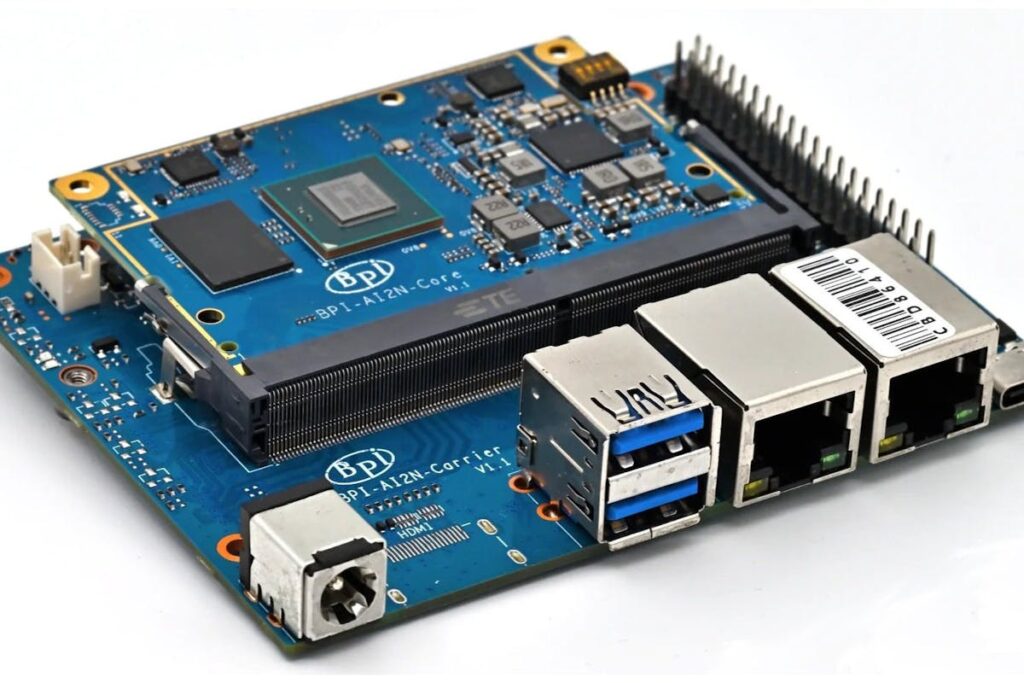
Sending every camera frame to a cloud API costs you a round trip. You pay for latency, you pay per call, and every frame of your lab or your factory floor leaves the building. Banana Pi’s new BPI-AI2N aims at that problem directly: a system-on-module that runs the inference locally and hands your carrier board a result instead of an image.
What Banana Pi actually shipped
The BPI-AI2N is a 69.6 x 45 mm core module built around the Renesas RZ/V2N, sold with a separate carrier board whose layout borrows heavily from NVIDIA’s Jetson dev kits. Module and carrier talk through a 260-pin SO-DIMM connector, so you can prototype on the reference carrier now and design your own PCB later without redoing the compute side. Banana Pi published schematics, assembly files, Linux images, and both Yocto and Armbian support at launch, which matters a lot when your thesis panel asks to see the source.
The numbers under the heatsink
A quad-core Arm Cortex-A55 at 1.8 GHz runs Linux while Renesas’ DRP-AI3 accelerator does the model work: 15 TOPS on sparse networks, 4 TOPS on dense ones. Read that gap carefully, because the headline figure assumes you have already pruned and quantized your model. A Cortex-M33 core sits alongside for real-time tasks, and a Mali-G31 GPU covers OpenGL ES 3.2. The module carries 8 GB of LPDDR4x, 32 GB of eMMC, 64 MB of SPI flash, and two Gigabit Ethernet controllers. Banana Pi rates it from -40°C to 85°C, which is the spec that decides whether your build survives a rooftop enclosure or an un-airconditioned shop.
Build it yourself
The carrier board exposes two MIPI CSI camera inputs, a MIPI DSI display connector, an M.2 Key-M slot for an NVMe SSD, a microSD slot, two USB 3.0 Type-A ports, a USB-C port for OTG and power, and a 40-pin GPIO header that will feel familiar to anyone who has wired a sensor to a Raspberry Pi. A realistic first build: one CSI camera over a conveyor or a seedling tray, inference on-module, and results published over MQTT from the second Ethernet port so the camera network stays off your campus LAN. If you hang I2C sensors on that 40-pin header, check the pull-ups first, because the module runs 3.3 V logic and most 5 V breakout boards need a level shifter.
Pricing is $293 for the BPI-AI2N-Core and $29 for the carrier, so this is a capstone-budget board rather than a weekend impulse buy. If you are scoping an edge vision project around it, size your model against the 4 TOPS dense number, not the 15 TOPS headline. Full spec breakdown at Hackster.
Frequently Asked Questions
How much AI performance does the BPI-AI2N actually deliver?
The Renesas DRP-AI3 accelerator is rated at 15 TOPS on sparse models and 4 TOPS on dense ones. Size your project against the 4 TOPS figure unless you have pruned and quantized your network, since the 15 TOPS headline assumes a sparse model.
What does a complete BPI-AI2N setup cost, and what else do I need?
The BPI-AI2N-Core module is $293 and the carrier board adds $29. On top of that you need at least one MIPI CSI camera module, a USB-C supply, and a microSD card or M.2 NVMe SSD for storage. Yocto and Armbian images are published, so there is no OS licence cost.
What will I learn if I build a project on this board?
You practise the full edge-AI workflow: training or picking a vision model, quantizing it so it fits an NPU budget, wiring a MIPI CSI camera, and moving results off the board over MQTT or Ethernet. You also pick up SO-DIMM module-plus-carrier design thinking, which is how commercial products separate the compute from the custom PCB. That combination reads well in a capstone defence or a hardware internship interview.
