
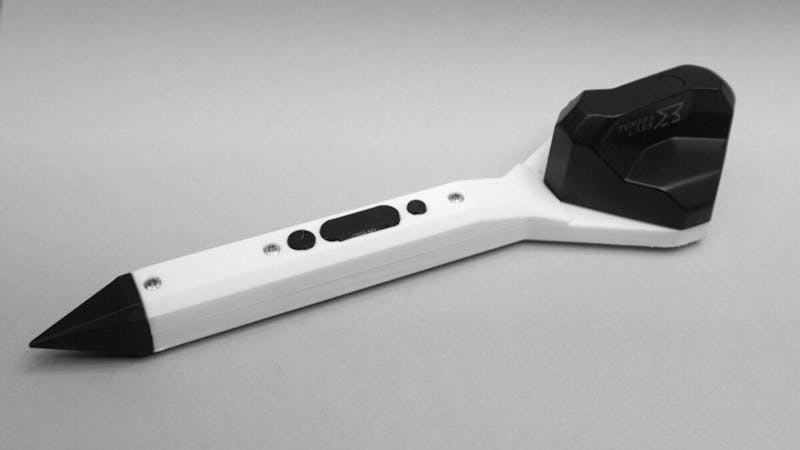
Sub-millimeter spatial tracking has stayed out of reach for most student labs for one reason: price. An OptiTrack rig runs $5,000 to $15,000, which is not a line item any ECE department approves for a thesis project. Krisjanis Rijnieks at Aalto University put together a 6-DoF stylus that lands under 1 mm of positional accuracy for roughly $155 in parts, and released the enclosure, boards, and software as open source.
What the Lighthouse Stylus actually does
The stylus is built for projection-based CAD. Your design gets projected onto the raw stock sitting on the bench, and you point at the material instead of glancing back and forth at a monitor. Because it tracks orientation as well as position, tilting the pen can set an angle, nudge an imported model into alignment, or scrub a parameter. A 3-DoF pointer cannot do any of that. Early tests had it measuring across a centimetre grid and sketching freehand with latency low enough that it felt like a pen.
The hardware, and the catch
Inside are two custom boards, a Button Board and an IO Board, joined by flexible printed cables and wrapped in a four-piece printed shell. Everything on that list can come off a normal fab lab bench with a PCB mill and a soldering iron. Tracking itself rides on Valve’s Lighthouse system through a Tundra Tracker module, and that is the honest catch: the base stations stay proprietary. One Valve Index base station brings the full system to about $340; two stations for better coverage push it to $524. Rijnieks points to open source tracking alternatives that are starting to appear.
Build it yourself
On the software side you run SteamVR on Windows or libsurvive on Linux. Python middleware handles calibration and talks to the tracker, then streams pose data over WebSockets as JSON to whatever browser app you write. A JavaScript library ships with it, so you are not parsing packets by hand. Two things to plan for before you cut any boards: base station placement decides your usable working volume, so map the bench first and mount at opposing corners, and the flex cable routing has to survive being held, so strain-relieve it where it meets the Button Board. Rijnieks is planning a harder evaluation next, measuring stroke accuracy against a CNC machine good for plus or minus 0.04 mm. Full write-up and parts list: Hackster’s coverage of the Lighthouse Stylus.
Frequently Asked Questions
What tracking technology does the Lighthouse Stylus use?
It reads Valve Lighthouse base stations through a Tundra Tracker module. SteamVR on Windows or the open source libsurvive on Linux decodes the sweep into pose data, giving better than 1 mm positional accuracy plus full orientation.
What does a complete setup cost to build?
The stylus itself is about $155 in parts: two custom PCBs (a Button Board and an IO Board), flexible printed cables and a four-piece printed shell. Add one Valve Index base station and you are near $340; a two-station setup for better coverage runs roughly $524.
What will I learn if I build this?
PCB layout and milling, flex cable routing and strain relief, calibrating a spatial tracker, and streaming live pose data from Python to a browser over WebSockets. Those four skills transfer straight into robotics, motion capture and HCI capstone work.
