
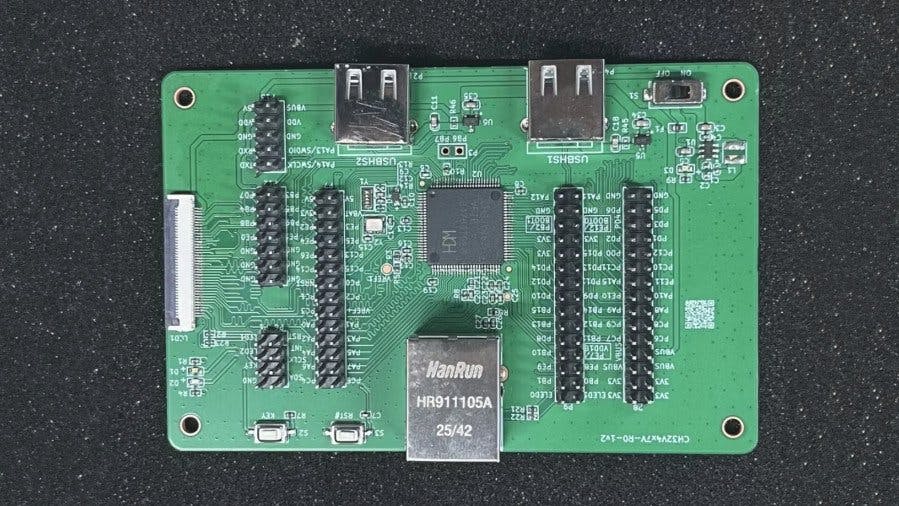
Vector math on a $2.40 chip is not where most of us expected 2026 to land. WCH Electronics has shipped the CH32V407, a 200MHz RISC-V microcontroller running the company’s QingKe core, and it carries the optional V-vector instruction set that usually shows up on parts costing ten times as much.
The CH32 line already had a following in the maker scene, mostly because WCH keeps undercutting everyone on price while still handing you a real 32-bit core. The V407 sits at the top of that range. It runs zero-wait at 200MHz, packs 200kB of on-chip SRAM and 512kB of flash, and its sibling, the CH32V467, adds a pseudo-static RAM interface that takes you up to 8MB of external PSRAM. That extra memory is the difference between demoing a tiny model and actually holding a frame buffer.
Why vector extensions matter here
The V extension lets one instruction chew through a batch of values instead of one at a time. On a microcontroller that translates to faster FFTs, quicker audio filtering, and on-device inference that does not fall over. If you have ever watched a keyword-spotting sketch stutter on an 8-bit board, this is the fix. Pair it with the two 12-bit ADCs and two DACs on board and you have a signal chain that stays entirely on the chip.
The rest of the pin count
- Up to 77 GPIO pins, mappable to 16 external interrupts
- Two USB 2.0 High Speed host/device ports at 480Mb/s
- Fast Ethernet MAC and PHY, no external controller needed
- 10 USART, 3 SPI, 2 I2S, 1 I2C, 1 I3C, 1 CAN 2.0B, 1 SDIO
- A 150MHz DVP camera interface and an LCD-TFT controller
- Hardware RNG, six timers, and an addressable RGB LED driver
Operating range is 2.9–3.6VDC, so it is a 3.3V part. Feed a 5V sensor line straight into a GPIO and you will let the smoke out. Level shifters or a divider on anything coming off a 5V rail, as always.
Build it yourself
Evaluation boards for the CH32V407 and the PSRAM-equipped V467 start at $17.99, which is the cheapest way in if you do not want to reflow a QFN yourself. You get one- and two-wire debug modes, so a WCH-LinkE probe is enough to step through code. The tricky part is toolchain setup: the MounRiver IDE is the path of least resistance, though a plain GCC RISC-V build works once you point it at the right linker script. Full peripheral tables and datasheets are on the WCH Electronics site, and the original write-up is at Hackster. Start with the ADC-to-DAC loopback example before you touch the vector unit, so you know your clock tree is right first.
Frequently Asked Questions
What separates the CH32V407 from the rest of the CH32 family?
Two things: the 200MHz clock with zero-wait flash access, and the optional V-vector instruction set for DSP and machine-learning workloads. Most CH32 parts run slower and skip the vector unit. The CH32V467 variant also adds a PSRAM interface for up to 8MB of external RAM.
How much does it cost to start building with one?
The bare chip is $2.40 at five-unit quantities, but for prototyping you want an evaluation board, which starts at $17.99. Add a WCH-LinkE debug probe and you can single-step code over the one- or two-wire debug interface without extra hardware.
What will I learn if I build this?
You pick up RISC-V assembly and toolchain setup, which is different enough from AVR or ARM to be worth the exercise. Beyond that: configuring clock trees, wiring an ADC-to-DAC signal chain, and getting hands-on with SIMD-style vector programming. Those last two show up constantly in thesis work on audio processing, embedded ML, and instrumentation.
