
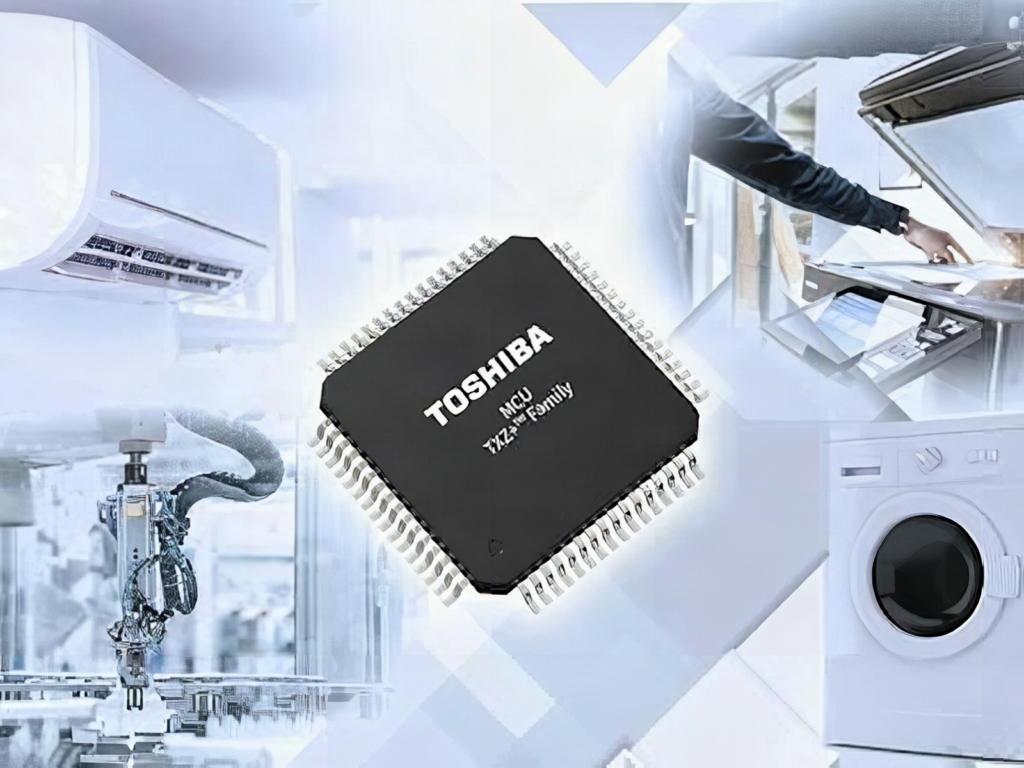
An “entry-level” chip with a floating-point unit and 120 MHz of headroom is a different animal from the 8-bit parts most thesis projects still start on. Toshiba just put its TXZ+ M4H family into mass production, and Hackster has the spec rundown.
What Toshiba shipped
The TXZ+ M4H line is aimed at general system control: appliances, consumer gadgets, and small industrial boxes. Each part is built around an Arm Cortex-M4F core that runs up to 120 MHz. Toshiba pitches it as a plain, easy-to-design-in controller rather than a chip tuned for one niche job. Three variants are listed at Farnell: TMPM4H4FYUG, TMPM4H1FYUG, and TMPM4H2FYDUG.
The numbers that matter on a bench
- 256 kB of flash, rated for 100,000 program/erase cycles
- 18 kB of SRAM with parity protection
- Up to 51 GPIO pins, depending on the model
- 3 or 4 UARTs, plus I2C and a TSPI serial port
- A 12-bit ADC, hardware CRC16/CRC32, and a 27- or 32-channel DMA controller
- External interrupts on 11, 12, or 16 pins
The tricky part for students is that 18 kB of RAM is tight next to an ESP32. A buffer for a 128×64 OLED already takes 1 kB, so plan your stack and any logging buffers early. The DMA controller is the real prize: it lets the ADC fill a sample buffer for a sensor or a microphone without the CPU touching every reading. The FPU also means filters and PID loops run in single-precision float instead of painful fixed-point math.
Build it yourself
You will not find a TXZ+ M4H board on a shelf yet, so use a Cortex-M4F board you can get today to practice the same ideas. An STM32 or similar M4F dev board works for a first try: read a sensor with the ADC through DMA, run a moving-average filter in float, and print results over UART at 115200 baud. Then tighten the build to fit in 18 kB of RAM, which is a great constraint for a capstone report. Compare against an Arduino Uno at 16 MHz and note the loop-time difference. Microcontrollers and sensor modules for this are at circuit.rocks, and the full announcement is on the source page.
Frequently Asked Questions
What core does the Toshiba TXZ+ M4H use?
An Arm Cortex-M4F running at up to 120 MHz, with a hardware floating-point unit. That makes filters and control loops much faster than on 8-bit parts.
How much memory do these chips have?
256 kB of flash rated for 100,000 erase cycles and 18 kB of parity-protected SRAM. The RAM is small, so firmware needs careful buffer planning.
What will I learn if I build this?
Working with a Cortex-M4F teaches you ADC with DMA, UART and I2C peripherals, floating-point filtering, and living within a tight RAM budget, all useful for thesis-level embedded work.
