
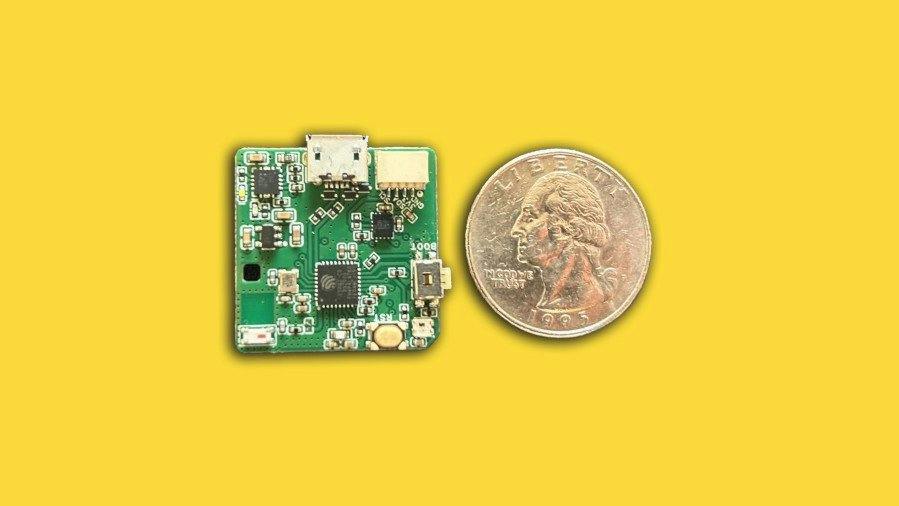
Most wearable sensor projects die on Saturday afternoon, somewhere between the breadboard and the battery. You get a pulse sensor talking to a dev board, then realize you still need a charger, a microSD slot, an IMU, and wireless streaming. TinZr is a weekend-sized answer to that problem: a 25 mm by 25 mm ESP32-C3 board, about the size of a one-peso coin and a bit, that already has all of those pieces soldered on.
What the NJIT team built
TinZr (say “TIN-zer”) comes from a group at the New Jersey Institute of Technology and Weill Cornell Medicine. It started as a wearable oximeter for jet pilots pulling heavy G-forces, and the board that grew out of it is deliberately generic. Project lead Ludvik Alkhoury describes it as an acquisition system you bolt sensors onto. The ESP32-C3 runs a single RISC-V core at up to 160 MHz with 2.4 GHz Wi-Fi and BLE 5.0, and the board adds an LSM6DS3TR-C six-axis IMU, a microSD reader for local logging, a chip antenna, a TI BQ24075 LiPo charger with power-path management, and a Qwiic connector that exposes the I2C bus with power and ground. Anything with SDA and SCL on a JST-SH cable plugs in without solder.
The published tests are what sell it. Streaming 100 Hz inertial data over BLE for 180 seconds showed zero packet loss out to 20 feet, through a wooden door, with RSSI dropping to about -89 dBm at the far end. With a 150 mAh cell, deep sleep draws 0.376 mA (about 16 days), active idle 14.8 mA (about 10 hours), and BLE streaming 41 to 61 mA, which works out to roughly 2.5 to 3.7 hours of continuous recording.
Parts and cost reality
The team puts the per-board cost at around $65 including shipping and customs, call it PHP 3,800, assuming you have the PCB assembled, since the ESP32-C3 and IMU packages are not hand-solder-friendly. EasyEDA project files, Gerbers, and a PLA enclosure (29.5 x 29 x 20 mm with the battery) are on GitHub under the CERN Open Hardware Licence, with firmware under GPLv3. The demo sensors are off-the-shelf: a MAX30102 breakout for red and infrared PPG, and a MAX30001 front end for single-lead ECG. A MAX30102 module costs a few hundred pesos at circuit.rocks; the MAX30001 is the pricey one. One gotcha from the paper: there is no medical-grade isolation, so keep this strictly a classroom or thesis instrument, never a clinical one.
Spend your Sunday on this
Clone the repo, open the TinZrConnect Arduino library, and flash the BLE streaming example to any ESP32-C3 dev board you already own (a Seeed XIAO ESP32C3 is the closest match). Wire a MAX30102 to GPIO 6 and 7 for SDA and SCL, pull the Python plotter from the same repo, and get a live PPG trace before dinner. Once that works, the only difference between your breadboard and the real TinZr is a PCB order. The full write-up lives in HardwareX, DOI 10.1016/j.ohx.2026.e00833, open access.
Frequently Asked Questions
What sensors can TinZr read?
Anything with an I2C, SPI, UART, analog, or digital interface. The team demonstrated a MAX30102 optical sensor for red and infrared PPG, a MAX30001 front end for single-lead ECG, and the onboard LSM6DS3TR-C IMU for motion. The Qwiic connector lets I2C sensors plug in without soldering.
How much does a TinZr cost and how long does the battery last?
The authors estimate about $65 per assembled board including shipping and customs. On a 150 mAh LiPo they measured roughly 16 days in deep sleep, about 10 hours idle, and 2.5 to 3.7 hours while streaming over BLE, depending on which sensors are active.
What will I learn if I build this?
I2C sensor integration over Qwiic, BLE and Wi-Fi streaming from an ESP32-C3, timestamp alignment between sensors sampling at different rates, LiPo charging with power-path management, and reading a HardwareX paper to reproduce a published design. It is a strong base for a biomedical or ECE thesis on physiological monitoring.
