
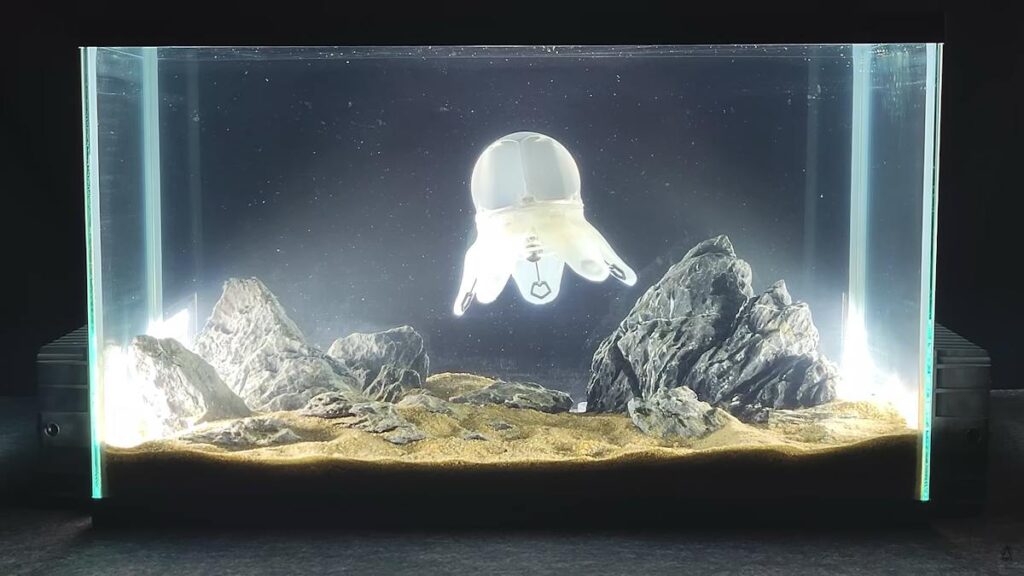
Bio-inspired robotics keeps showing up in student competitions and research labs: fish-tail swimmers, insect-style walkers, soft grippers. Animals solved locomotion long before anyone wrote a motor driver. Robert Skinner’s solar-powered robot jellyfish sits squarely in that trend, but with a twist that makes it a great teaching project. It runs with no battery and no wall plug, pulsing around an aquarium on nothing but light collected by five small solar panels glued to its bell.
The build itself
Skinner sketched the idea three years ago: a translucent jellyfish, panels on the dome, every mechanical part hidden inside. He warmed up with a walking “pet rock” named Rocky that ran a motor straight off a solar-charged battery, an approach that does not scale down to a jellyfish. The propulsion side went through several failed mechanisms (spinning tentacles, stacked snail cams that jammed, half gears that pushed unevenly) before he settled on a saw-tooth cam. The cam drives a 7:1 gear reduction and pushes a ring of hinged rods outward; a molded silicone bell then springs back and squeezes water downward, exactly how a real jellyfish moves. A laser-cut acrylic plate separates the wet side from the electronics, with gaskets and a rotary shaft seal keeping water out. A thicker resin dome was swapped in late to add ballast so the thing would actually sink between pulses. Total parts spend was about $300, roughly PHP 17,000.
The technical takeaway: harvest slowly, spend in bursts
The tricky part was power. Tiny panels under aquarium lamps cannot drive a motor continuously, so Skinner used the BEAM-robotics trick: a capacitor charges slowly from the panels, a Schottky diode stops charge leaking back, and a MOSFET dumps the stored energy into the motor in one short burst. His first version used a comparator to fire the MOSFET at a set capacitor voltage, but the switching was never clean, so he moved the decision into an ATtiny85. The 8-pin AVR runs happily from 1.8 V to 5.5 V, which suits a sagging capacitor rail. One gotcha cost him two days: the motor and the microcontroller shared a single capacitor, so every pulse collapsed the rail and reset the ATtiny several times a second. The first “working” run had only worked because the programming cable was still plugged in and quietly feeding the circuit. A second capacitor dedicated to the ATtiny85 fixed it. Watch the full build on YouTube at https://www.youtube.com/watch?v=35T9oz1o83g.
What to try next
You do not need an aquarium to copy the useful half of this project. Breadboard the energy-burst circuit first: a 1,000 µF capacitor, a 1N5819 Schottky diode, a logic-level MOSFET such as the IRLZ44N, a 5 V solar panel, and an ATtiny85 reading the capacitor voltage on an ADC pin (PB3 works) before firing the gate from PB0. Program it over USB with a Digispark-style bootloader; CircuitDigest has a walkthrough at circuitdigest.com. Add the decoupling capacitor on the ATtiny85 supply from day one and you skip Skinner’s two lost days.
Frequently Asked Questions
How does the robot jellyfish move without a battery?
Five small solar panels on the bell slowly charge a capacitor. When the ATtiny85 sees enough voltage, it switches a MOSFET that dumps the stored charge into a motor. A saw-tooth cam on a 7:1 gear reduction pushes hinged rods outward, and the silicone bell springs back to push water down, giving one swimming pulse per burst.
What parts do I need to copy the energy-burst circuit?
A 5 V solar panel, a 1,000 µF capacitor for energy storage, a smaller decoupling capacitor for the microcontroller, a 1N5819 Schottky diode, a logic-level MOSFET like the IRLZ44N, an ATtiny85, and a small DC gearmotor. Skinner’s full jellyfish ran about $300 in parts, but the breadboard version of just the power circuit costs a few hundred pesos.
What will I learn if I build this?
Energy harvesting and burst-mode power management, reading a capacitor voltage with an ADC and driving a MOSFET gate from a microcontroller, why shared supply rails cause brown-out resets and how decoupling capacitors fix them, basic cam and gear mechanism design, and sealing electronics against water. These are the same skills behind solar IoT nodes and soft-robotics thesis projects.
