
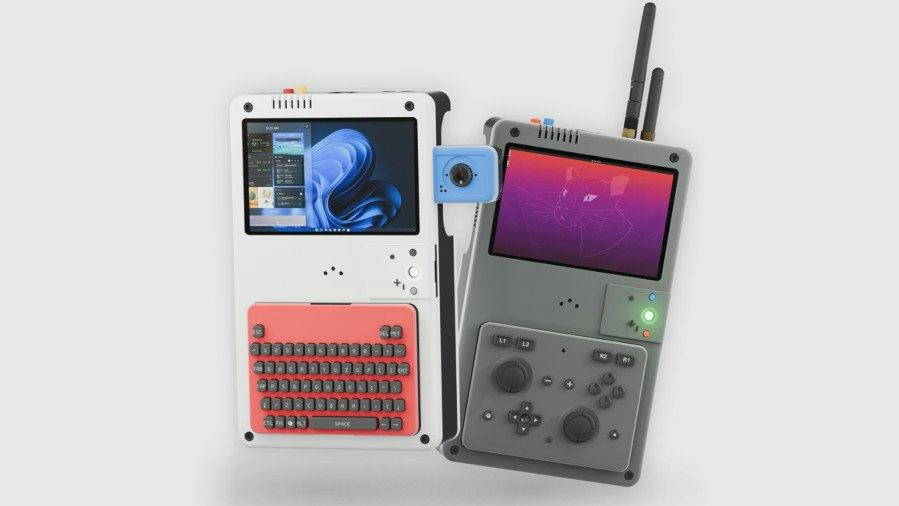
Open hardware is having a handheld moment. Framework proved people will pay for a laptop they can fix with one screwdriver, Clockwork’s uConsole showed makers want a pocket Linux terminal, and the Steam Deck taught gamers that a PC does not have to look like one. The CG Deck from two-person startup Mogozen sits where those three ideas meet: an x86 handheld whose schematics, KiCad files, and STL files are promised as open source once its Kickstarter closes.
What Mogozen built
The CG Deck wraps around the LattePanda IOTA single-board computer, which carries an Intel N150, a 4-core chip paired with 8 GB or 16 GB of LPDDR5 and 64 GB or 128 GB of eMMC storage. A 5-inch capacitive touchscreen sits up top, with HDMI 2.1 (4K60), wired Ethernet, two USB 3.0 Type-A ports, microSD, and a 3.5 mm jack around the edges. Power comes from three 18650 LiFePO4 cells rated at 10,500 mAh combined, good for about 8 hours of idle runtime according to Mogozen. An optional module adds an M.2 slot for an NVMe SSD.
The clever part lives below the screen. A recess accepts swappable input modules: a 64-key clicky microswitch keyboard with rubber or hard-plastic keycaps, a gamepad with dual Hall-effect analog sticks, or a 10-key macropad with a rotary knob. A second, smaller bay takes a trackball, and two USB cameras (1 MP fixed-focus or 8 MP autofocus) complete the lineup. Nothing needs a soldering iron to swap.
The technical takeaway
Modularity is a decision you make at the schematic stage, not a feature you bolt on later. For hot-swap bays to work, every module has to speak the same protocol over the same connector, which is why USB is the sensible pick for keyboards, gamepads, trackballs, and cameras alike. The battery choice teaches something too: LiFePO4 cells sit at 3.2 V nominal instead of the 3.7 V of a regular lithium-ion 18650, so each cell stores less energy but survives far more charge cycles and runs cooler. Three cells in parallel is how the CG Deck reaches 10,500 mAh, and the boost converter between that pack and the 5 V rail is where most student handheld builds go wrong. Hall-effect joysticks read a magnet’s field instead of a wiper on a resistive track, so they never develop the drift of cheap potentiometer sticks.
What to try next
You do not need $299 to learn from this design. A Raspberry Pi Zero 2 W, a 3.5-inch SPI touchscreen, and a Pico programmed as a USB HID keyboard will teach you the same host-plus-module architecture for a fraction of the price. Lay the carrier board out in KiCad (free at kicad.org) and leave a header footprint for a second input bay even if you never populate it. Then read the full pricing breakdown on Hackster: early-bird DIY kits start at $299 without the IOTA board (roughly PHP 17,500 before shipping and customs) and climb to $1,299 for the fully loaded Max bundle, with hardware slated to ship in March 2027. Crowdfunding never guarantees delivery, so treat it as a design reference first.
Frequently Asked Questions
What computer is inside the CG Deck?
A LattePanda IOTA single-board computer with an Intel N150 4-core processor, 8 GB or 16 GB of LPDDR5 RAM, and 64 GB or 128 GB of eMMC storage. Because it is x86, it runs standard Windows or Linux desktop builds rather than ARM-only images.
How much does the CG Deck cost and what is included?
Early-bird Kickstarter pricing starts at $299 for a DIY kit that does not include the LattePanda IOTA board. The top tier is $1,299 for the 8 GB/128 GB Max model with the IOTA, every input module, and the 8 MP camera. Mogozen says hardware ships in March 2027 and that KiCad, STEP, and STL files will be published after the campaign.
What will I learn if I build something like this?
Battery pack design with LiFePO4 cells and a boost converter, how USB HID lets several input modules share one host connector, KiCad carrier-board layout for a single-board computer, and the mechanical side of fitting a touchscreen and swappable modules into one enclosure. It is a solid capstone project for an ECE or computer engineering thesis.
