
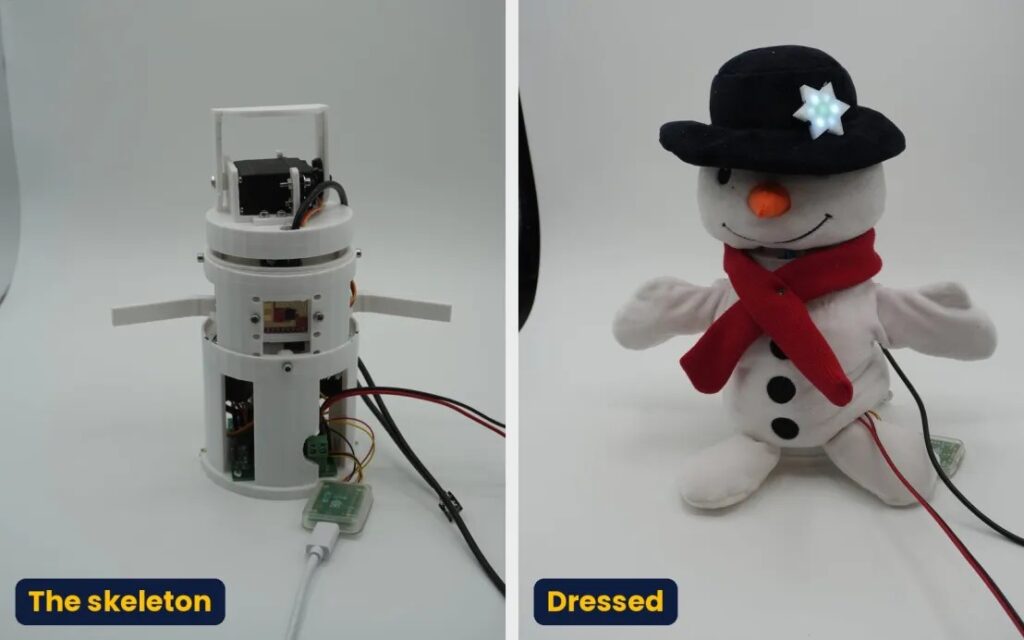
Walk into the room and the snowman wakes up. A blue heartbeat pulses in the star on his hat, his head turns toward you, and when you step closer he waves. Stand too close and the star turns red and he shakes his head at you. No hand inside, no camera: a Raspberry Pi Pico 2 W, four hobby servos and a 24 GHz radar module do all of it.
What Dr Jon built
UK maker Dr Jon EA started with a second-hand snowman hand puppet, cut the head off at the neck, and slid the body over a stack of printed cylinder sections that hold the electronics. The control board sits at the bottom, the two arm servos in the middle, and a pan-tilt mechanism on top so the face lands about 13 cm above the base. A Keywave KW307 radar looks out straight through the fur, and a 7-LED WS2812B disc becomes the star badge on his hat. The personality is a hierarchical state machine, roughly 300 lines of C++, with six states from Asleep to Attending, all driven by one number: how far away you are.
Technical details worth stealing
Two gotchas make this build useful long after Christmas. The Pico‘s PWM hardware is split into slices, each with one counter and two channels, A and B. The pico-servo library Jon used tracked one servo per slice, so his three slices meant three servos. He forked it so each slice drives two servos, which takes the RP2350A from 8 to 16 servos; the fork is at github.com/drjonea/pico-servo. The radar on UART1 (GPIO 8 and 9, 115200 baud) also throws the odd wild distance frame, and a single spike would flip the star red or trigger a greeting. Every reading now passes through a median of the last five samples, then a light exponential average. Near/far switching uses hysteresis too: you are “near” inside 1.5 m but only count as “far” again past 2 m, so he stops flickering when you stand on the boundary. One more lesson from filming day: a long extension lead sagged the servo supply under load and the arms stopped short. Measure the voltage at the robot while it moves, not at idle.
Build it yourself
Everything, including the printable skeleton and the firmware, is on GitHub at https://github.com/DrJonEA/Snowman2026, with the full write-up at drjonea.co.uk. For a local parts list: a Pico 2 W, four SG90 or MG90S servos, a WS2812B ring and a separate 5 V 2 A supply for the servos (never run four servos off the Pico‘s 3V3 pin). The KW307 is the hard-to-find part; an HLK-LD2410 24 GHz presence sensor is easier to buy here and also talks UART, though you will rewrite the frame parser. If two servos share a PWM slice, both channels must run at the same 50 Hz, which suits hobby servos fine. Get one servo easing smoothly on a breadboard first, then add the state machine, then the rest of the body.
Frequently Asked Questions
How does the radar snowman know where people are?
A Keywave KW307 24 GHz radar reports distance and angle over UART1 at 115200 baud. The firmware takes a median of the last five frames, smooths them with an exponential average, and picks one target: a stationary person first, otherwise the nearest moving one. The star colour, the gesture choice and the near/far state all key off that one distance.
Why did a standard Pico servo library only allow three servos?
The reused driver board exposes five servo headers that sit on just three PWM slices, and the original pico-servo library tracked one servo per slice. The fork indexes servos by slice and channel so channel A and B each get their own servo, which allows up to 16 servos on the RP2350A.
What will I learn if I build this?
How PWM slices and channels work on the RP2040 and RP2350, interrupt-driven servo easing, parsing a UART sensor, median and exponential filtering of noisy readings, hysteresis thresholds, and structuring behaviour as a hierarchical state machine. It is a capstone-sized embedded project that still fits in a term.
