
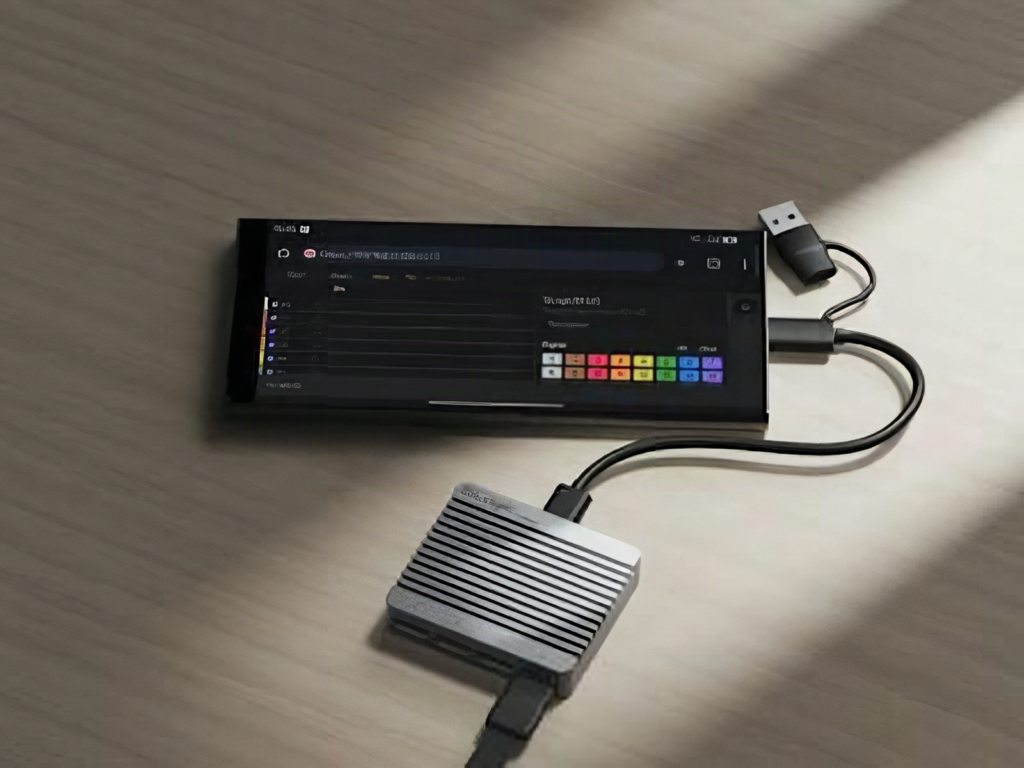
Bench instruments keep getting cheaper, and logic analyzers are the clearest example. Ten years ago a USB analyzer that could catch a 100 MHz signal cost more than most student thesis budgets. Sipeed’s new SLogic32U3, now on Kickstarter, pushes the trend further, and Hackster has the full rundown.
What Sipeed announced
The SLogic32U3 is the third model in the SLogic family. It plugs into a PC over USB 3.2 Gen 2 (10 Gb/s) and offers 32 digital channels. Sample rate depends on how many channels you use: 1.4 GS/s on 4 channels, 800 MS/s on 8, 400 MS/s on 16, and 200 MS/s with all 32. Maximum input frequency is 350 MHz, up from 200 MHz on the SLogic16U3. Early backer pricing starts at $149.
The technical takeaway
Two changes matter for everyday debugging. First, the stream buffer grows from 16 kB to 256 MB of DDR3, so long captures no longer drop samples. Second, an optional ADC module adds four 8-bit analog channels at 100 MS/s, which lets you see a sensor’s analog output next to the SDA and SCL lines that read it. The software side is just as useful: a browser app called SLogicWeb uses WebUSB, so it runs on Linux, Windows, macOS, and Android with no install, and it ships with over 150 protocol decoders borrowed from the Sigrok project.
The gotcha is the same as with any crowdfunded gear. Shipping is promised for November, but delivery is never guaranteed, so do not plan a deadline around it.
What to try next
You do not need a 1.4 GS/s analyzer to learn this workflow. A $10 Saleae-style 8-channel clone and the free Sigrok PulseView app will decode I2C, SPI, and UART at 24 MHz, enough for most Arduino and ESP32 thesis projects. Hook channel 0 to SDA and channel 1 to SCL on your OLED, capture one startup, and check that the address byte reads 0x3C. If it reads 0x3D or nothing, that is your bug. Once that habit sticks, pick up a faster analyzer when your project hits SPI at 40 MHz or more. Arduino and ESP32 boards, jumper wires, and breadboards for practice are available at circuit.rocks.
Frequently Asked Questions
How fast is the SLogic32U3 logic analyzer?
It samples up to 1.4 GS/s on 4 channels, 800 MS/s on 8, 400 MS/s on 16, and 200 MS/s on all 32, with a 350 MHz maximum input frequency over USB 3.2 Gen 2.
What does the optional ADC module add?
Four 8-bit analog channels sampled at 100 MS/s, so you can view an analog sensor signal alongside the digital bus lines that carry its readings. The add-on pair costs $19.
What will I learn if I build this?
Using a logic analyzer teaches you to read I2C, SPI, and UART traffic, confirm device addresses, and spot timing faults, skills every ECE student needs for debugging a capstone project.
