
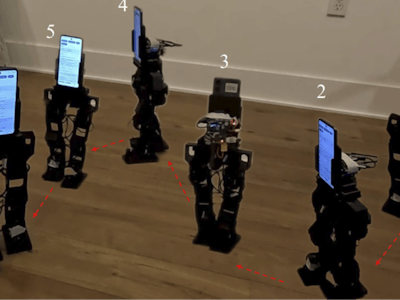
That cracked Android phone in your drawer already has a 2 GHz-class processor, a camera, and an IMU. UCLA researchers wired one onto a pair of legs and called it PhoneBot, an open source humanoid that costs about $400 to build before you add the phone. Hackster covered the project, and it is a neat template for a school robotics team on a tight budget.
What they built
PhoneBot stands about 19 inches tall and weighs 4 pounds. It has no arms or head, just two legs and a rotating torso, so the phone camera can follow a person without the feet moving. The phone rides in a mount above the hips and does the thinking, while a small onboard computer relays commands to the servos over Wi-Fi. Because the link is wireless, swapping phones does not touch the wiring. The team tested four handsets, including a 2017 Honor 9 and three budget models at roughly $50 to $80 each, and all four ran the core functions.
How it works
The body has 13 joints, all driven by DYNAMIXEL XL430-W250-T servos: three per hip, one per knee, two per ankle, plus one for the torso. The phone’s IMU reports body tilt, and its camera handles object detection and human tracking. A custom Android app runs the walking and balance networks with TensorFlow Lite.
The tricky part was the gait. Early reinforcement learning runs in simulation left one leg doing most of the work. The fix, called sagittal mirroring, duplicates each training sample with left and right swapped. That cut joint-angle asymmetry from 0.254 to 0.003 radians. The gotcha: the controller only learned flat ground, and the cheap servos limit payload.
Build it yourself
You do not need 13 servos to borrow the idea. Mount an old phone on a two-wheel chassis, stream IMU and camera data over Wi-Fi to an ESP32, and drive two motors from the ESP32 GPIO pins through a motor driver. Start with line following or face tracking, then try a balancing loop. ESP32 boards, servo motors, and jumper wires are available at circuit.rocks, and the research team’s source page above links the full paper.
Frequently Asked Questions
What does PhoneBot use for sensing and control?
An Android smartphone provides the camera, IMU, and processor. It runs TensorFlow Lite networks and sends commands over Wi-Fi to a small onboard computer that drives 13 DYNAMIXEL XL430 servos.
How much does PhoneBot cost to build?
About $400 excluding the phone. The researchers tested handsets from a 2017 Honor 9 to budget models costing roughly $50 to $80, and all handled the core functions.
What will I learn if I build this?
You will practice servo control, sensor fusion with an IMU, wireless links between a phone and a microcontroller, and how reinforcement learning trained in simulation transfers to real hardware.
