
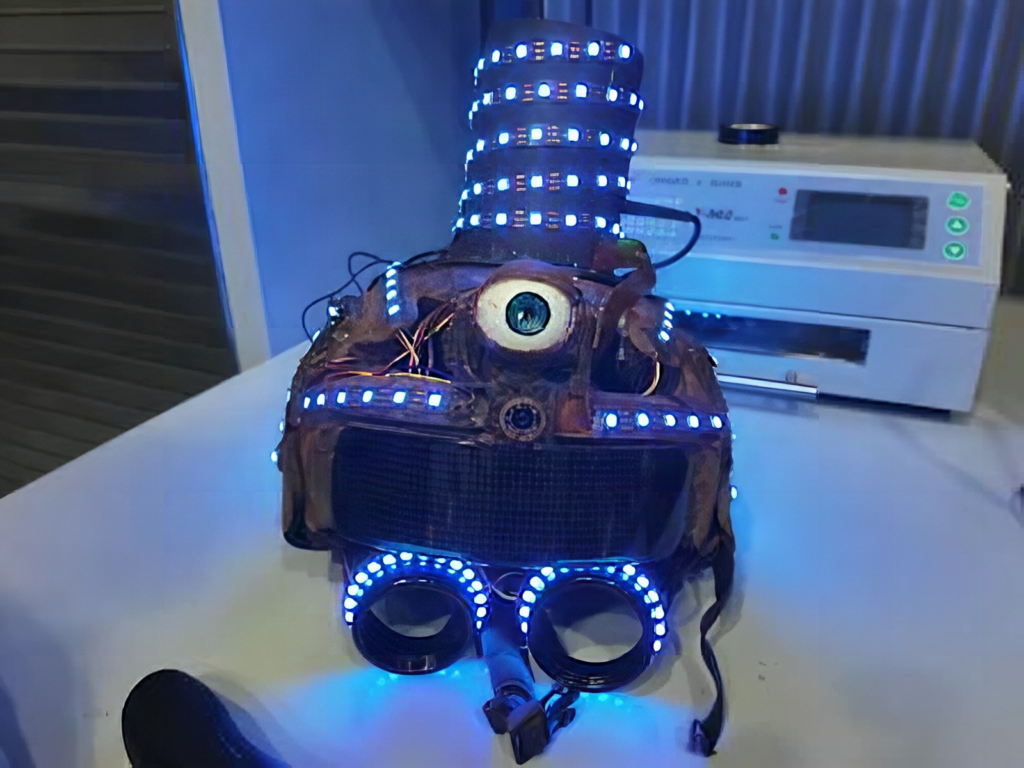
Can a Raspberry Pi 5 run a talking AI, a servo-driven eyeball, LED effects, and a live video feed at the same time, strapped to someone’s head, with zero internet? DeepSea Developments says yes, and their Mind-Control Helmet V2 is the proof.
What the helmet actually does
Built for Burning Man, the steampunk helmet broadcasts its own Wi-Fi hotspot named “Mind Control.” Anyone who joins it opens a browser control panel and can watch the helmet’s camera, change the lighting, steer a big animatronic eye, talk through the onboard speakers, or chat with the built-in AI assistant. The whole thing runs offline, which matters in a desert where cell signal is a rumor. The eye comes from an open-source printable design, but the interesting part is the electronics stack behind it.
How the hardware splits the work
The build uses two brains, and that split is the lesson worth copying.
- Raspberry Pi 5 + AI HAT+: hosts the hotspot, the web UI, video streaming, and a local 1.5-billion-parameter Qwen 2.5 language model. Voice runs on-device too: OpenWakeWord listens for the trigger phrase, a speech-to-text library turns speech into a prompt, and Piper speaks the reply.
- Seeed XIAO ESP32-S3: drives the addressable LED strips and rings, the eye servos (pan, tilt, blink, eyelids), and a handheld wireless remote.
- Camera Module 3 NoIR: the no-IR-filter version was picked for better low-light video at night events.
Why not run the servos straight from the Pi’s GPIO? Because Linux is not real-time. When the Pi is busy with LLM inference and a video stream, a servo pulse can jitter and the eye twitches. Handing timing-critical jobs to a 240 MHz ESP32-S3 keeps the eye smooth while the Pi handles the heavy lifting. A classic gotcha to watch for: the Pi runs 3.3 V logic and hobby servos want their own 5 V supply, so give servos a separate rail with a shared ground instead of powering them from a board pin.
Try it on a smaller budget
You don’t need the full helmet to learn from this. Start with an ESP32-S3 and two SG90 servos on a breadboard, write a tiny serial protocol (for example “E,90,45” for eye pan and tilt), and send commands from a Pi or laptop over UART. Once that works, add a WS2812 LED ring on one data pin and a wake-word model on the Pi. That’s a solid capstone scope for a two- or three-person ECE team. Full write-up and photos are on Hackster.
Frequently Asked Questions
How does the helmet run an AI assistant without internet?
A Raspberry Pi 5 with an AI HAT+ runs a 1.5-billion-parameter Qwen 2.5 model locally. Wake-word detection (OpenWakeWord), speech-to-text, and Piper text-to-speech all run on the Pi, so no cloud connection is needed.
Why does the build use an ESP32-S3 alongside the Raspberry Pi?
The XIAO ESP32-S3 handles timing-sensitive jobs like servo pulses, addressable LEDs, and the wireless remote. The Pi runs Linux, which is not real-time, so offloading those tasks keeps the eye and lights smooth while the Pi does AI inference and video streaming.
What will I learn if I build a version of this?
You’ll practice splitting a system between a Linux computer and a microcontroller, writing a simple serial command protocol, powering servos from a separate 5 V rail, driving WS2812 LEDs, and running offline speech and language models on a Raspberry Pi.
