
Cloud security cameras keep landing in the news for the wrong reason: strangers watching feeds they were never meant to see. A growing group of makers has answered by pulling the camera off the internet entirely, running person detection on the device and keeping every frame at home. Clem Mayer’s latest build is a sharp example of where that privacy-first, edge-AI trend is heading.
The build itself
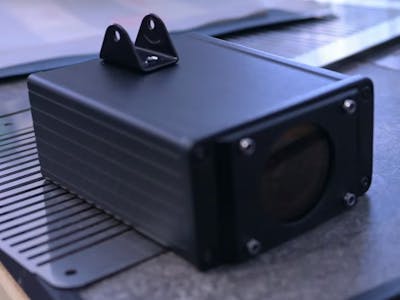
Mayer designed a self-contained camera around the PocketBeagle 2 single-board computer. It runs person detection locally, records to local media, and keeps working through a power outage thanks to an onboard 18650 battery tied into the board’s power management. A custom PCB acts as the spine, folding power distribution, battery backup, and USB into one board. Because the PocketBeagle 2 has few native interfaces, a Microchip USB2514 hub controller lets it talk to the camera, storage, and networking hardware at the same time. Everything sits inside a watertight Hammond aluminum enclosure, with the front glass and swivel mount salvaged from a dead dummy camera.
The technical takeaway
Two details are worth stealing. First, thermal design: a heatsink bonded to the aluminum housing turns the whole case into a passive heat spreader, which also keeps frost off the front window in cold weather. Second, a debugging lesson. Mayer’s intermittent network dropouts turned out to be a slight voltage sag under heavy processor load, not a software bug. Nudging the 5 V supply output up restored stable operation. Detection runs on OpenCV plus a lightweight deep neural network on the board itself, so recording only starts when a person walks into frame and stops seconds after they leave. Clips are stored locally and auto-deleted after 72 hours, with USB storage available to extend that.
What to try next
You do not need this exact hardware to borrow the idea. Run a person-detection DNN on a Raspberry Pi or ESP32-CAM, write clips to a local SD card, and skip the cloud account entirely. Watch your supply rail under load with a multimeter before blaming your code, and give any sealed enclosure a real heat path. Full build notes, the PCB details, and a video are on Mayer’s write-up at Hackster.io.
Frequently Asked Questions
How does this camera detect people without the cloud?
It runs OpenCV with a lightweight deep neural network directly on the PocketBeagle 2, so person detection happens on the board. Recording starts when someone enters the frame and stops a few seconds after they leave, which cuts storage use sharply.
What keeps it running during a power outage?
An onboard 18650 battery connects through the PocketBeagle 2’s built-in power management circuitry, backed by a 5 V supply. A custom PCB handles power distribution and USB, and clips are stored locally and auto-deleted after 72 hours unless you add USB storage.
What will I learn if I build this?
You will practice on-device computer vision, PCB power distribution, USB hub integration, and thermal design for a sealed enclosure. You will also learn to debug hardware first: the builder’s network dropouts were a voltage sag under load, not code, a habit that saves hours on any embedded project.
