
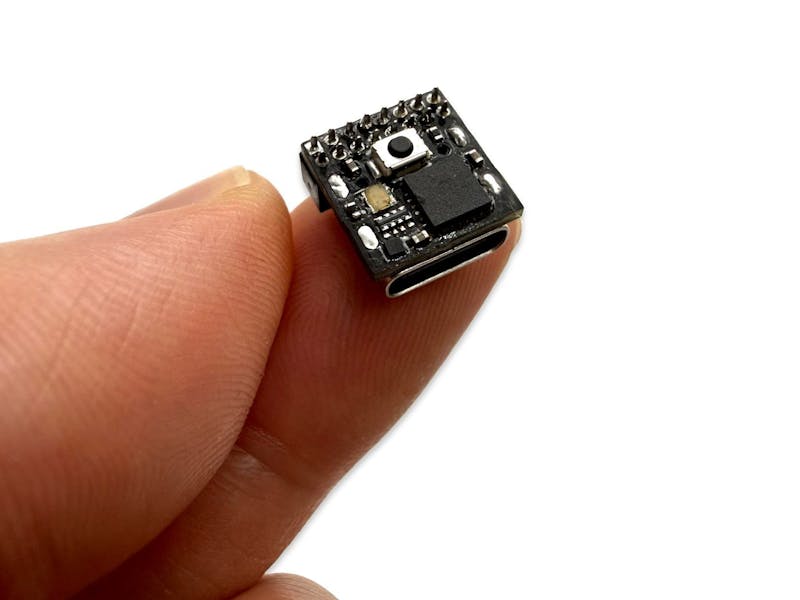
Set a grain of rice next to the Moddo Pinch and the two are practically neighbors in size. This 32-bit, Arduino-compatible dev board measures just 10.5 x 10.9 mm and tips the scale at 1.1 g, which makes its footprint barely larger than the USB-C port bolted to one edge. For comparison, Seeed Studio’s popular XIAO SAMD21 is 21 x 17.8 mm, so the Pinch squeezes into under a third of that area.
What you can actually do with it
Tiny does not mean toy. The Pinch is aimed at builds where every millimeter counts: wearables sewn into a cuff, a sensor node tucked inside a small keyfob, or a thesis project where the enclosure has to disappear. Because it speaks the Arduino IDE out of the box, you flash it the same way you would any Uno or Nano, so the learning curve for a first-year ECE student stays flat. The catch is real estate. With a board this small, you get an RGB LED, a reset/bootloader button, and not much else on deck, so most of your parts live off-board on a breakout or a scrap of perfboard.
The specs under the hood
At the center sits a Microchip SAM D11 with an Arm Cortex-M0+ core running up to 48 MHz, backed by 4 KB of SRAM and 16 KB of flash. That is modest headroom, so keep your sketches lean. The board exposes 15 GPIO pins, 12 of them broken out to the header. Of those, 11 do PWM, five read analog, one is a true DAC, plus one I2C, one SPI, and two UART lines. A 3.3 V LDO handles regulation. There is no battery management and no extra flash, so an external EEPROM over I2C is your friend for data logging.
Build it yourself
Pre-orders are open at $15.90 with units shipping in September, and any SAM D11 toolchain will program it if you would rather skip the Arduino IDE. Because the header pitch is standard, you can solder on right-angle pins and drop the Pinch straight onto a breadboard for prototyping before committing it to a final build. Start with the RGB LED blink to confirm your bootloader, then wire an I2C sensor to pins SDA and SCL and watch how little space the whole rig takes. Full specs and photos are on the Hackster writeup.
Frequently Asked Questions
Just how small is the Moddo Pinch?
The board measures 10.5 x 10.9 mm and weighs 1.1 g, so its footprint is barely larger than its own USB-C port and less than a third the area of a Seeed XIAO SAMD21.
What microcontroller does the Pinch run, and what does it cost?
It uses a Microchip SAM D11 with an Arm Cortex-M0+ at up to 48 MHz, 4 KB SRAM, and 16 KB flash. Pre-orders are $15.90 with shipping expected in September.
What will I learn if I build with the Pinch?
You will practice flashing a SAM D11 through the Arduino IDE, budgeting tight SRAM and flash, wiring I2C and SPI peripherals off-board, and designing compact layouts where the microcontroller has to fit inside a wearable or a small enclosure.
