
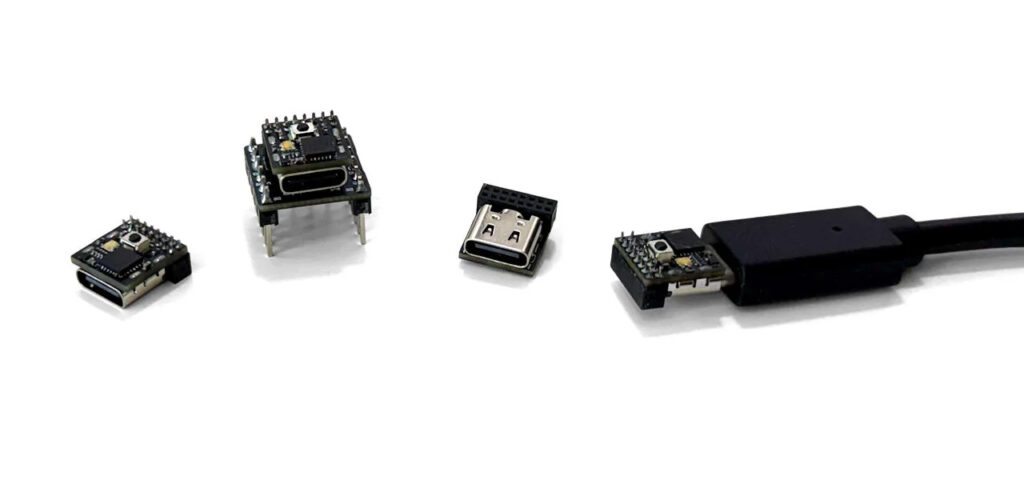
You know that weekend project idea that stalled because the dev board was bigger than the thing you wanted to hide it inside? A wearable, a keyfob mod, a sensor tucked into a bottle cap? The pinch from moddo is the board that finally makes those builds realistic.
A whole Arduino the size of a USB-C plug
moddo calls the pinch “the world’s smallest 32-bit Arduino-compatible board,” and while nobody has the record book out, it is hard to argue. The whole thing takes up about the same surface area as a female USB-C connector. Under the hood sits a Microchip SAMD11, an ARM Cortex-M0+ running at 48 MHz, with native USB so you flash it straight over the cable with no separate programmer. You get 15 GPIO pins plus the usual SPI, I2C, PWM, and UART, which is plenty for a small sensor node or a blinky wearable.
The parts-and-cost reality
Two things to keep in mind before you plan a build around it. First, the specs are tight: 4 KB of SRAM and 16 KB of flash, and the bootloader eats 4 KB of that flash right off the top, leaving you roughly 12 KB to work in. Coming from an ESP32 you will feel the squeeze, so skip heavy libraries, watch your String usage, and lean on direct register writes if you run out of room. Second, it is a pre-order: the $16 board (roughly PHP 900) is slated to ship in September, so this is a plan-it-now, solder-it-later project.
- MCU: Microchip SAMD11, Cortex-M0+ at 48 MHz
- Memory: 4 KB SRAM, 16 KB flash (about 12 KB usable)
- I/O: 15 GPIO, native USB, SPI, I2C, PWM, UART
- Bonus: a breakout board ships with it so you can breadboard the pins
Worth a Sunday of planning
The circuit schematic and a STEP 3D model are already public, with the full board design files close behind, so you can lay out your enclosure or PCB before the board even lands on your bench. Read the specs straight from the source at moddo.io/pages/pinch, decide which sensor you would wire to those 15 pins, and have your firmware ready for the day it arrives.
Frequently Asked Questions
What microcontroller powers the Pinch board?
A Microchip SAMD11 with an ARM Cortex-M0+ core running at 48 MHz, native USB, 15 GPIO pins, and SPI, I2C, PWM, and UART. Memory is tight at 4 KB SRAM and 16 KB flash, with the bootloader taking 4 KB of that flash.
How much does the Pinch cost and when does it ship?
It is a $16 pre-order (roughly PHP 900) with a planned September ship date. A circuit schematic and STEP 3D model are already public, and the full board design files are expected soon.
What will I learn if I build with the Pinch?
You will get hands-on with a resource-constrained ARM microcontroller: writing lean firmware, managing 12 KB of usable flash, using direct register access instead of heavy libraries, and wiring SPI or I2C sensors to a compact GPIO header. Good practice for embedded and wearable projects.
