
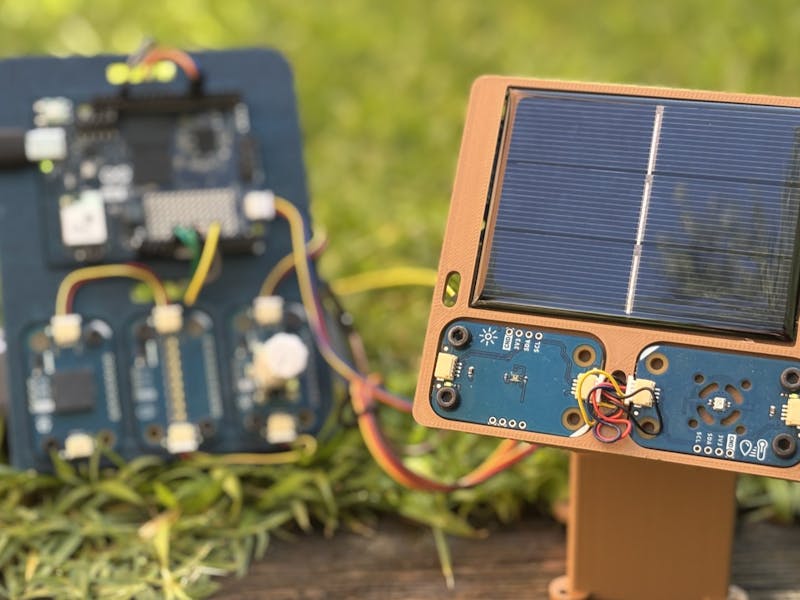
Clear a spot on the bench this weekend, because this is the kind of build that pays you back every sunny day after. Julián Caro Linares put together a smart solar panel that aims itself at the sun, shakes off its own dust, and ducks into a safe position when the weather turns. It runs on an Arduino UNO Q, and every design file is open source.
What you’re actually building
The heart of it is an Arduino UNO Q 4GB paired with a stack of Modulino expansion boards. A two-axis mount driven by a pair of MG90 servos swings the panel across the sky, logging light readings as it goes and parking at whatever angle produces the most output. Those readings get stored in a database, so over a day the system draws a live heat map of where the strongest sun is coming from.
Four sensors doing the work
A Light module reads both visible and infrared, a Thermo module tracks temperature and humidity, and a Movement module trips a shutdown if it feels an odd vibration or impact. The clever part: a Modulino Vibro shakes the panel to dislodge dust and sand, a trick borrowed from planetary rovers instead of brushes or compressed air.
Parts and cost reality
This isn’t a five-minute breadboard job. The UNO Q’s 4GB Linux side runs a forecast fetcher and hosts a dashboard on your local network, which means you are wiring servos, mounting four sensor modules, and printing the mechanical parts before anything moves. FreeCAD files and 3D-printable mounts are published, so the mechanical side is solved if you have printer access. Budget one weekend for assembly and a second for tuning the tracking logic.
Spend your Sunday on this
Grab the full build, wiring notes, and Arduino code from the Arduino Project Hub and start with the tracking loop before you add the cleaning and weather features. Get two servos sweeping toward a light sensor first, confirm the panel finds the brightest spot, then layer in the Thermo and Vibro modules once the basics hold. By Sunday night you could have a panel that follows the sun on its own.
Frequently Asked Questions
How does the solar tracker clean itself?
A Modulino Vibro module shakes the panel to knock off dust, sand, or snow, a vibration technique inspired by planetary exploration hardware. It avoids brushes and compressed air entirely.
What hardware do I need to build one?
An Arduino UNO Q 4GB, Modulino Light, Thermo, Movement, and Vibro modules, two MG90 servos for the two-axis mount, plus 3D-printed FreeCAD mounts and a solar panel.
What will I learn if I build this?
You practice servo control, sensor fusion across light, temperature, and motion inputs, closed-loop sun tracking, and hosting a live dashboard on the UNO Q’s embedded Linux side. It is a strong thesis or capstone project.
