
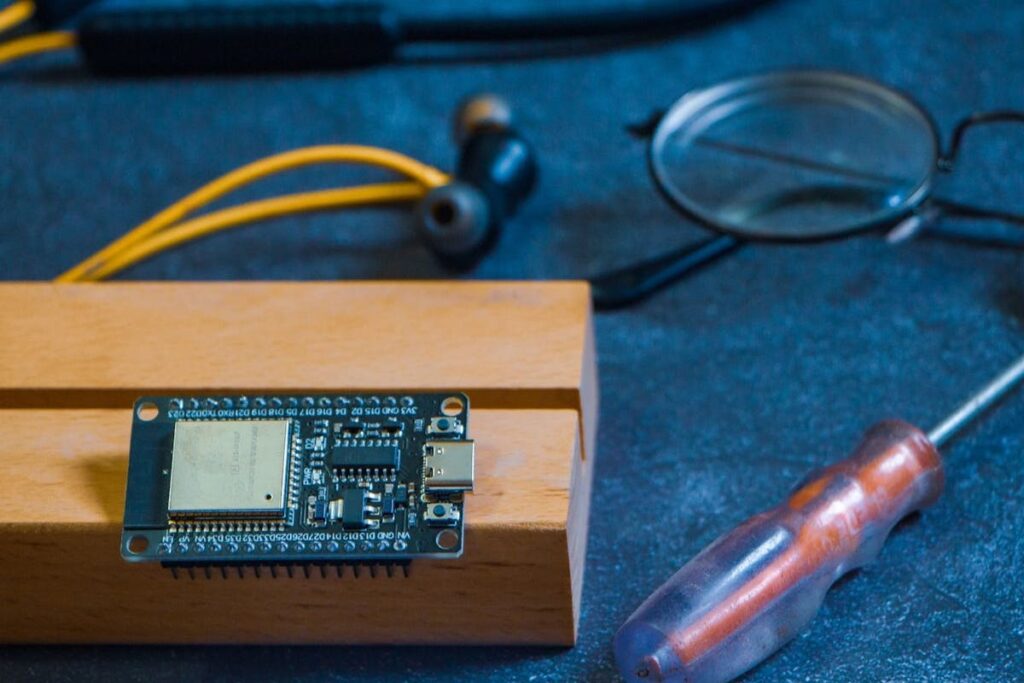
You are holding a gadget with no screen and no buttons, and you want it on your Wi-Fi. So you just say the network name out loud, and the chip hears you, understands the command, and connects. No phone app, no cloud account, no server round-trip. That live demo, running on a bare Raspberry Pi RP2350, is what got makers talking about Moonshine Micro this week.
What the team built
Moonshine Micro is an open-source framework that packs a full voice pipeline onto microcontrollers costing under a dollar. It is the trimmed-down sibling of the larger Moonshine Voice project, rebuilt for embedded processors and DSPs. The toolkit ships as three separate neural-network libraries: voice activity detection to spot when someone is actually talking, speech-to-text to turn that audio into words, and a text-to-speech engine to talk back. Because each piece is modular, you can drop in just the wake-word detector, or wire all three together into a complete offline voice assistant.
How it fits on a tiny chip
The clever part is the memory budget. The whole system runs inside the RP2350’s 520 KB of RAM, using roughly 468 KB by sharing memory between each stage of the pipeline instead of giving every stage its own buffer. Speech recognition leans on a compact model called SpellingCNN, and the heavy math runs on TensorFlow Lite Micro. The current release handles command recognition rather than free conversation: it recognizes about 50 custom words or phrases, and you can retrain the models on your own vocabulary. Everything is released under the permissive MIT License, so it is fair game for classroom builds and commercial products alike.
Why this matters for your bench
Voice control used to mean a Raspberry Pi 4 and a constant internet connection. Moving the whole stack onto a 520 KB microcontroller changes the math for any battery-powered or privacy-sensitive build: a voice-tagged inventory bin, a hands-free lab timer, an accessibility switch for a capstone project. The RP2350 already has the dual-core headroom and the RAM, so the barrier now is mostly your microphone wiring and a bit of retraining. Grab the code from the project’s GitHub repository, flash it to an RP2350 board, and start with the 50-word command set before you retrain it for your own thesis demo. Full write-up is on Hackster.io.
Frequently Asked Questions
How does Moonshine Micro run voice recognition without the cloud?
It uses three modular neural-network libraries (voice activity detection, speech-to-text, and text-to-speech) built on TensorFlow Lite Micro, all running on-device inside the RP2350’s 520 KB of RAM.
How many commands can it recognize, and can I change them?
The current release handles about 50 custom words or phrases, and you can retrain the SpellingCNN model on your own vocabulary. It targets command recognition, not open conversation.
What will I learn if I build this?
You will pick up hands-on embedded machine learning: wiring a microphone to an RP2350, flashing a TensorFlow Lite Micro model, managing a tight RAM budget, and retraining a small neural network for your own command set. Great groundwork for a thesis or capstone.
