
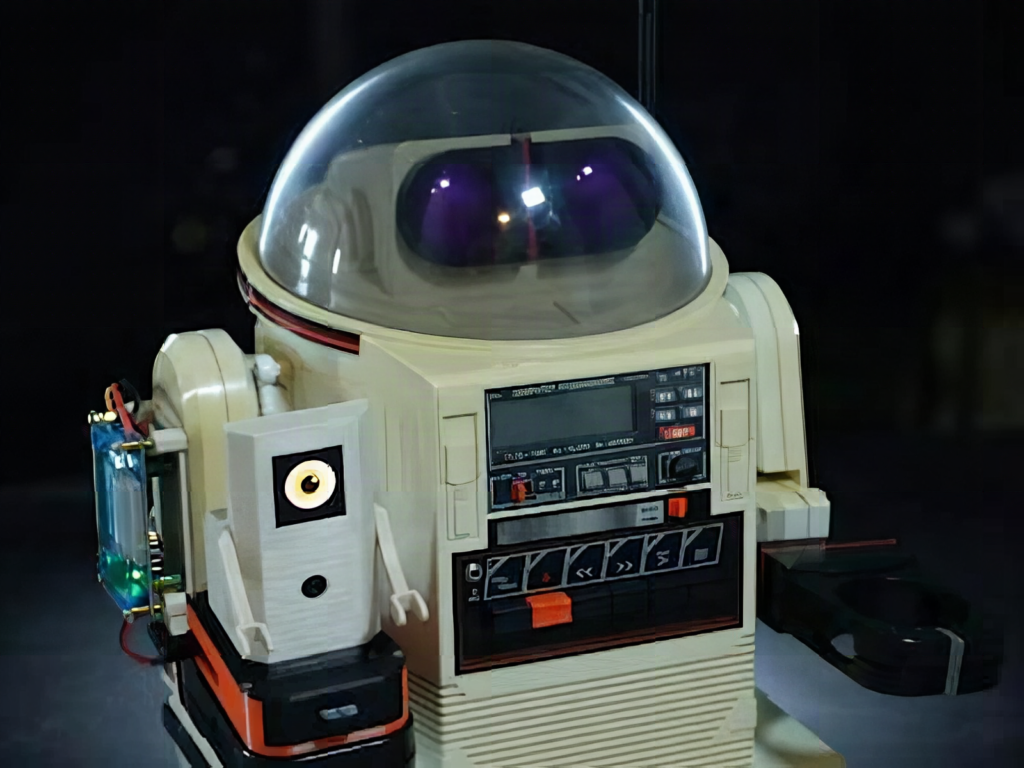
A donated 1984 Tomy Omnibot lands on a workbench at Moonlighter FabLab in Miami. Battery acid has eaten into the circuit board, and the rubber wheels have crumbled. Most people would shelve it. Maker Mario Cruz grabbed a soldering iron instead, as Hackster.io reports.
What Cruz built
After cleaning the corrosion and soldering the damaged traces, the Omnibot rolled again. Then came the upgrade: a bolt-on companion called Ring-O, developed with maker Placitech. It rides along with the robot and carries a Raspberry Pi 5 with 8 GB of RAM, a Sony IMX500 AI camera, a small fan, a battery, and a 128×128 OLED that acts as an animated eye. The eye blinks, follows movement, and reacts to what the camera detects.
How it works
The clever part is how Cruz avoided rewiring the old robot. The Omnibot’s cassette deck reads audio tones as drive commands, one frequency for forward, another for turn left. So a Bluetooth cassette adapter plus a Raspberry Pi script that generates those tones sends movement commands over the air, and the original motor electronics keep doing their job after 40 years.
Vision runs on the IMX500 itself. It executes a YOLO11-nano model that recognizes 80 object classes, so the Pi never carries the inference load. Cruz first let a cloud-hosted LLM pick movements, but replies took about 15 seconds and the driving was poor. He swapped in a few hardcoded rules, and the robot got faster and more reliable. A web interface lets you tell it to find a person, find a shoe, or dance, and an LLM can describe the scene out loud. The code is on GitHub under an MIT license.
The takeaway
Latency decides whether a robot feels alive. A 15-second round trip to the cloud is useless for a rover, while a rule that runs locally in milliseconds wins. For a thesis or capstone, put detection on the camera, keep decisions on the Pi, and call an LLM only for talking. Another gotcha: audio-tone control means your tone timing matters, so test every command on a bench before the robot goes near a table edge. To start small, pair a Pi with a camera board and an OLED from circuit.rocks, then compare local rules against a cloud call. Read the full build at the source article.
Frequently Asked Questions
How does the Raspberry Pi control the old Omnibot?
The Omnibot’s cassette deck decodes audio tones into drive commands. A Bluetooth cassette adapter and a Pi script that generates those tones send forward and turn commands wirelessly, so the original motor electronics stay untouched.
What hardware does the Ring-O companion use?
A Raspberry Pi 5 with 8 GB RAM, a Sony IMX500 AI camera running YOLO11-nano for 80 object classes, a 128×128 OLED eye, a fan and a battery. The code is MIT licensed on GitHub.
What will I learn if I build this?
You practice on-camera object detection, generating audio signals from a script, serial and I2C display wiring, and choosing between cloud LLM calls and fast local rules, which suits ECE thesis and robotics competition work.
