
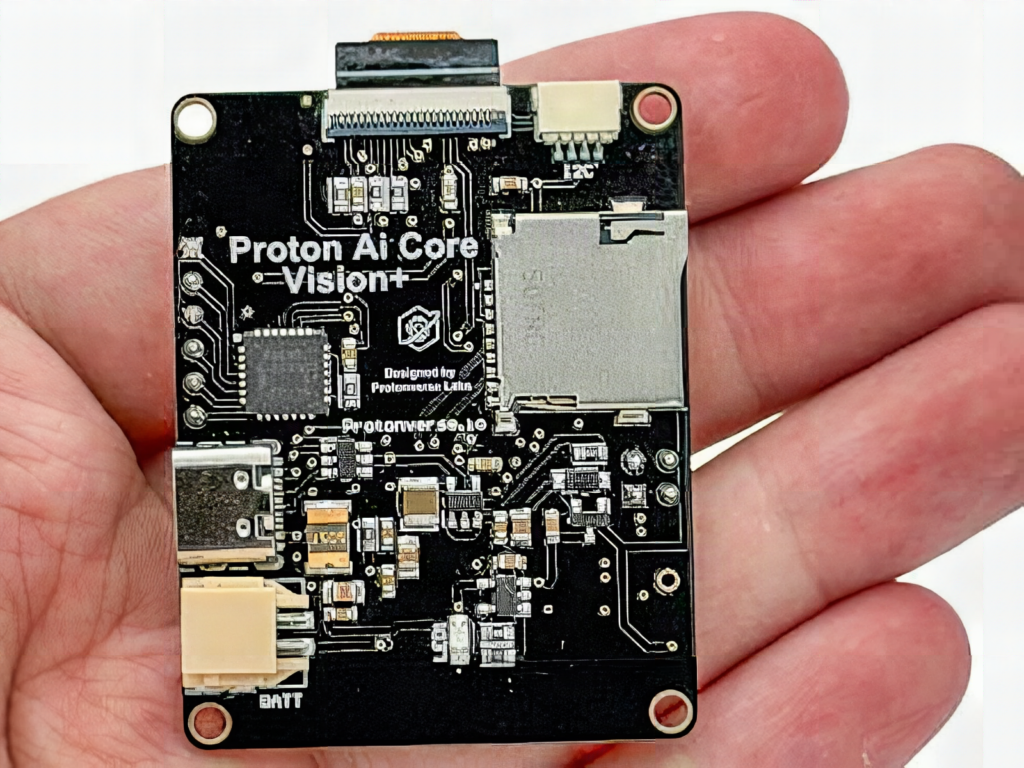
Picture a Saturday where the camera, microphone, and motion sensor you need for a smart-workshop hack are already on one board, with no jumper wires to debug before lunch. That is the pitch behind the Proton AI Core Vision+ from Protonverse Labs, covered by Hackster.io.
What is on the board
The brain is an Espressif ESP32-S3-WROOM-1-N16R8 module: a dual-core Xtensa LX7 at up to 240 MHz, 16 MB of flash, and 8 MB of PSRAM, plus 2.4 GHz Wi-Fi and Bluetooth 5 LE. A 5 MP OV5640 camera connects over a flex cable, with a flash LED for dark corners. Audio comes from an ICS-43434 digital MEMS microphone, and an ICM-42670-P six-axis IMU reports acceleration and gyro data. All three sensors can run at the same time, which is the part many camera boards cannot do.
Parts and cost reality
Extras are built in: a microSD slot, a Qwiic/STEMMA QT connector for I2C add-ons, one addressable RGB LED, and an ATECC608B secure element. Power is USB or a single-cell LiPo with onboard charging. Code runs in Arduino, MicroPython, or ESP-IDF, and the browser-based Protonverse Studio offers block coding with live camera and sensor views. The honest gotcha: a crowdfunding campaign is planned, but pricing and a launch date are not announced, and the PCB layout files stay closed. Schematics, docs, and Arduino firmware are open.
The ESP32-S3 has no dedicated NPU, so expect lightweight models such as simple object or keyword detection, not heavy vision. In the Proton Swarm demo, several boards plus an Arduino UNO Q log where tools were last seen in a shared workshop. A school lab could copy that idea for a shared soldering station.
Spend your Sunday on this
You cannot order the board yet, so rehearse with what is on the shelf today. Grab an ESP32-S3 camera board, wire an I2S microphone to three pins (BCLK, WS, DATA), and add an MPU6050 on SDA and SCL with 4.7k pull-ups if your module lacks them. Get frames and audio levels printing over serial at 115200 baud first, then add detection. Browse ESP32 boards and sensors at circuit.rocks, and watch the source article for the launch date.
Frequently Asked Questions
What processor does the Proton AI Core Vision+ use?
An Espressif ESP32-S3-WROOM-1-N16R8 with a dual-core Xtensa LX7 up to 240 MHz, 16 MB flash, 8 MB PSRAM, Wi-Fi and Bluetooth 5 LE. It has no dedicated NPU, so it runs lightweight models.
Can I buy the board and how is it programmed?
Not yet. A crowdfunding campaign is planned without announced pricing or date. It supports Arduino, MicroPython, ESP-IDF and the browser-based Protonverse Studio. Schematics and firmware are open source.
What will I learn if I build this?
You practice combining a camera, an I2S microphone and an I2C IMU on one ESP32-S3, managing PSRAM, and running small on-device models. Useful for ECE capstone projects and school robotics entries.
