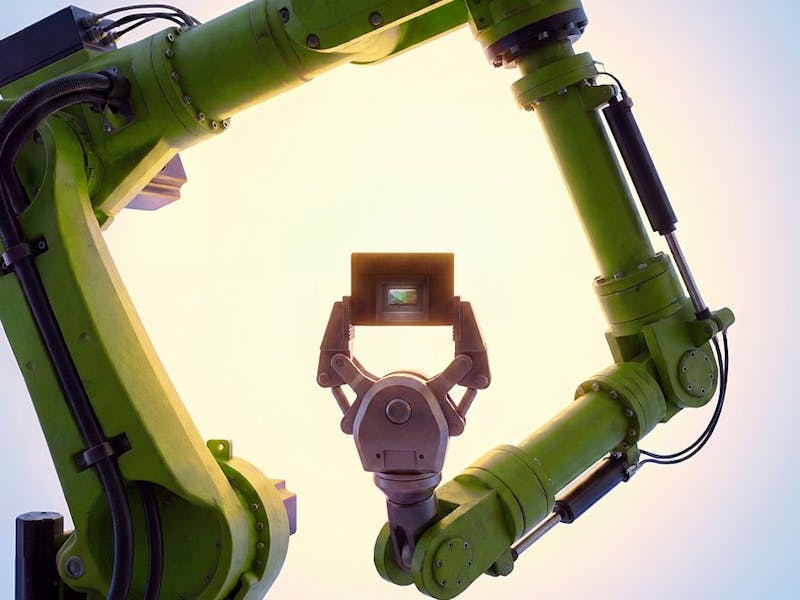
The robots are leaving the lab. Warehouses, factories, and store floors are filling up with machines that need to see, reason, and act on their own, and every one of them is hungry for AI compute that used to live in a server rack. NVIDIA’s answer this round is to shrink that compute instead of growing it. Two fresh Jetson modules, the T3000 and T2000, pull the Blackwell-powered Thor architecture down into smaller, cooler-running packages aimed squarely at edge robotics.
What NVIDIA actually announced
The T3000 sits near the top of the lineup, pushing 865 FP4 teraflops of AI compute from a module that is roughly half the size and draws half the power of the older T5000. Inside sits a Blackwell GPU paired with an eight-core Neoverse Arm CPU, 32GB of LPDDR5X memory, 273GB/s of memory bandwidth, and 25 GbE networking. Below it, the T2000 targets lighter jobs with 400 FP4 teraflops and 16GB of memory, a better match for mobile robots and visual AI agents than for a full humanoid.
The technical takeaway
The interesting part is not raw numbers, it is efficiency. The T3000 hits inference performance close to the T5000 on multimodal workloads like vision-language-action models, at half the power budget. NVIDIA also leaned on software: new Jetson agent skills automate memory optimization, and companies like UBTech and Agile Robots trimmed as much as 15GB of memory use, letting apps that once needed a 64GB AGX Orin drop to a 32GB board. Alongside the hardware sits Cosmos 3 Edge, a four-billion-parameter world foundation model that runs on-device so a robot can predict and generate its own actions.
What to try next
Hardware ships in Q1 2027, but you do not have to wait to experiment. T3000 emulation arrives this month with JetPack 7.2.1, so an existing Jetson AGX Thor developer kit can mimic the new module’s behavior today. For students and thesis teams, that means you can prototype a perception pipeline now, port your CUDA libraries, and be ready when the smaller boards land. No need to solder anything to start poking at the SDK, and the emulation path is the cheapest way to learn where your model bottlenecks before spending on silicon. Read the full breakdown at the Hackster news post.
Frequently Asked Questions
What makes the Jetson T3000 different from the older T5000?
The T3000 delivers about 865 FP4 teraflops of AI compute in a module roughly half the size and half the power draw of the T5000, while keeping similar inference performance on multimodal workloads. It pairs a Blackwell GPU with an eight-core Arm CPU, 32GB of LPDDR5X, and 273GB/s of memory bandwidth.
When can I actually get one, and do I need the hardware to start?
The T2000 and T3000 modules are expected in Q1 2027, but you can begin now. T3000 emulation ships this month with JetPack 7.2.1, so an existing Jetson AGX Thor developer kit can emulate the new module’s performance before the silicon lands.
What will I learn if I build a project on a Jetson module?
You will pick up practical edge-AI skills: deploying vision-language-action models, optimizing memory so a model fits a smaller board, running on-device inference with CUDA libraries, and wiring perception into a robot’s control loop. Those are exactly the skills capstone and robotics-team projects need.
