
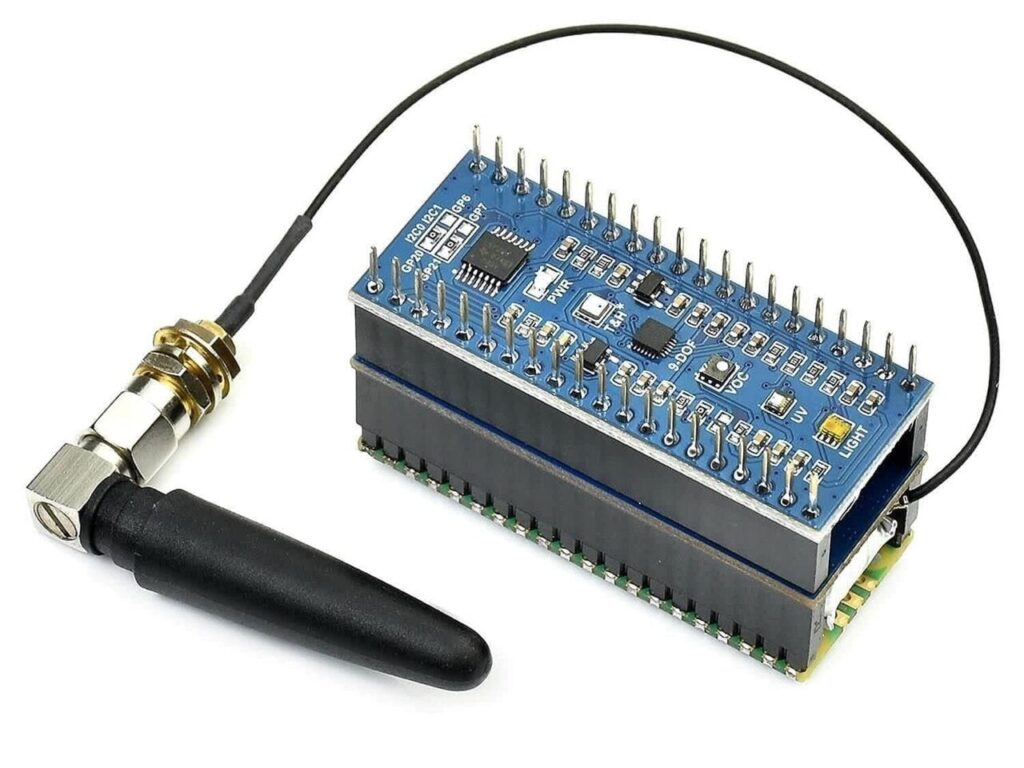
Your Raspberry Pi project runs great until it has to send data from the far end of the farm, past the last bar of Wi-Fi. That is a perfect Saturday-afternoon problem, and LoRa is the fix. It pushes small packets at 300bps to 50kbps and can reach up to 15km (9 miles) in open rural areas, plenty for a sensor sitting in a field or a gate at the end of a long driveway.
What you can build in an afternoon
Two add-on boards make this a plug-and-go weekend project. The Waveshare SX1262 LoRa Node Module is built for the Raspberry Pi Pico: solder male headers onto a Pico, press it into the module’s twin female headers, and you are wired. The SX1262 transceiver runs more efficiently and reaches a little farther than the older SX1276, and the kit bundles a 600mAh 3.7V LiPo so your node can walk away from the wall socket.
Want an all-in-one? The Perpetuo LoRa board bakes an RP2350 chip, the same one on Pico 2, right onto the radio alongside an Embit EMB-LR1276S module. It talks to a LoRaWAN gateway like The Things Network, or peer-to-peer with a second node. A Qwiic/STEMMA QT connector lets you clip on an I2C sensor without soldering.
Parts and cost reality
The Waveshare module runs about $19 (roughly PHP 1,100), battery included, so a Pico node lands cheap. The Perpetuo is around $28 and needs its own LiPo, but its USB-C port charges it and can even run off a small solar panel for an off-grid station. One rule you cannot skip: connect the antenna before you power up any LoRa board, or you risk frying the radio. Match the frequency to your region too, 915MHz here in the Philippines and the US, 868MHz in Europe.
Spend your Sunday on this
Grab a Pico, a LoRa module, and the SX126x library, flash a hello-world packet, and walk to the far end of your street to watch it arrive. Check the rules first: LoRa rides the licence-free ISM band, but duty-cycle and transmit-power limits still apply. The full board rundown is on the Raspberry Pi news post.
Frequently Asked Questions
How far can a LoRa node on a Raspberry Pi Pico actually transmit?
Up to about 15km (9 miles) in open rural areas, and much less in a dense city with walls and interference. Data rates run 300bps to 50kbps, so it is built for small sensor packets, not video or big file transfers.
What parts do I need to build a LoRa node on a Pico?
A Raspberry Pi Pico with male headers, a LoRa add-on like the Waveshare SX1262 module (about $19, with a 600mAh LiPo and antenna included), and an antenna matched to your region (915MHz in the Philippines and US, 868MHz in Europe). Always connect the antenna before powering on.
What will I learn if I build this?
You pick up SPI radio communication, reading a transceiver datasheet, ISM-band radio rules, power budgeting with LiPo and solar, and the difference between peer-to-peer LoRa and a LoRaWAN gateway. That is a strong foundation for an IoT thesis or a field-sensor capstone project.
