
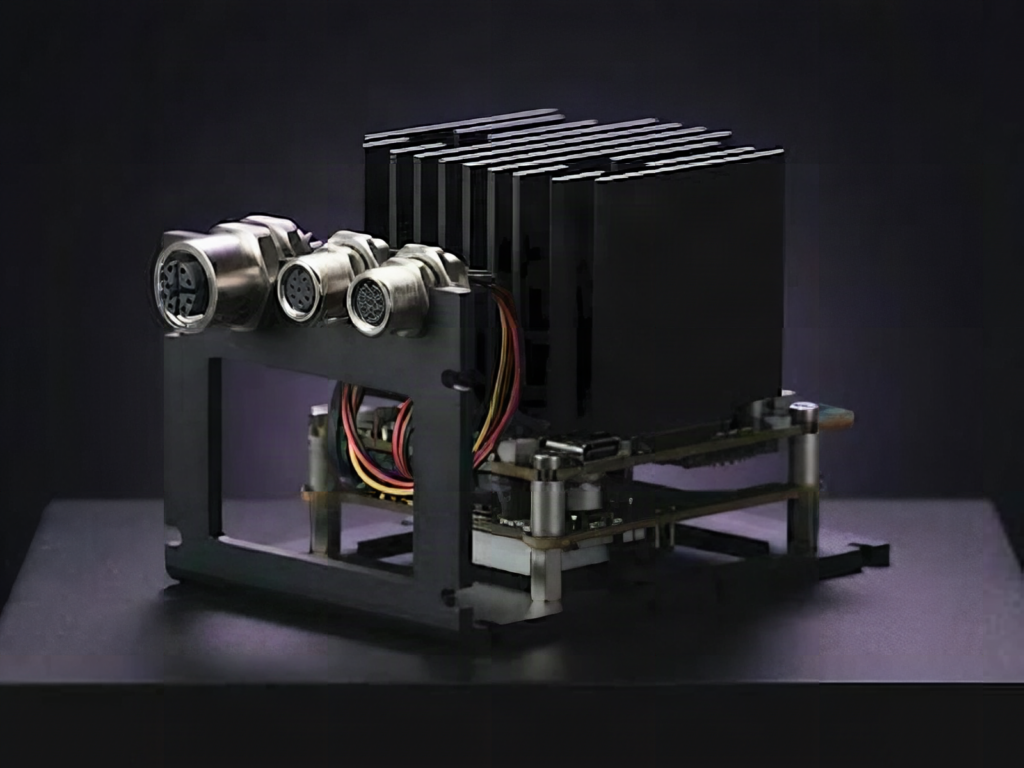
Picture a school robotics bench the night before a regional competition. The team’s mobile robot has one camera bolted to the front, and it keeps missing a ball rolling in from the left. Somebody tapes a second webcam to the side, the USB hub overheats, and the frame rate drops to a crawl. That is the problem Luxonis is aiming at with its new OAK 4 FFC board, covered in this Hackster.io report.
What Luxonis built
The OAK 4 FFC is a carrier board for the OAK 4 system-on-module. It has five flat flexible circuit connectors wired to five four-lane MIPI CSI camera inputs, so one board can watch in several directions at once. You pick the sensors: the 48 MP Sony IMX586, the 1 MP Omnivision OV9828 monochrome global-shutter, or the 5 MP Omnivision OG05. The module packs a six-core Arm processor plus a neural coprocessor rated at 48 TOPS INT8 (12 TOPS FP16) for on-device vision models.
How the pieces connect
Depth from a stereo camera pair is calculated on the board, along with feature tracking, so the host computer does not burn cycles on it. For wiring, there is a 2.5 Gb Ethernet port on an M12 connector, a USB-C port up to 5 Gb/s, and expansion over SPI, I2C, UART, I2S, CAN bus and GPIO. An SD card slot handles local storage, and a six-axis IMU plus a three-axis magnetometer sit on the board. PoE+ comes through an optional add-on module, which means one cable can carry power and data to a moving robot. A gotcha for budget-minded teams: the barebone board is $729 and the dev kit is $829, both with a temporary $200 surcharge for memory and storage.
What to take from it
You will not pay that price for a classroom set, but the design idea transfers. Mount cameras where the robot needs eyes, and push the heavy vision math onto the camera board instead of the main controller. If your team is stuck on a Raspberry Pi or ESP32-CAM, try running a single camera with a small neural network first, then add a second view only when you can show the first one is the bottleneck. Luxonis also offers an open hardware reference design for the carrier board, which is worth reading as a real example of routing MIPI lanes. Start with the source article and browse circuit.rocks for Raspberry Pi and camera modules to prototype with.
Frequently Asked Questions
How many cameras can the OAK 4 FFC handle?
Up to five, through five FFC connectors tied to four-lane MIPI CSI inputs. You can mix 48 MP, 1 MP mono global-shutter and 5 MP global-shutter sensors.
What does the board cost and what is in the box?
The OAK-4-FFC-BAREBONE is $729 (carrier plus OAK 4 module) and the OAK-4-FFC-DEVKIT is $829, adding a PoE+ module, connectors, heatsink and L-bracket. Pricing includes a temporary $200 memory surcharge.
What will I learn if I build this?
You practice multi-camera placement, stereo depth, running neural networks on edge hardware and wiring CAN, I2C and UART peripherals, skills that fit ECE thesis and robotics competition work.
