
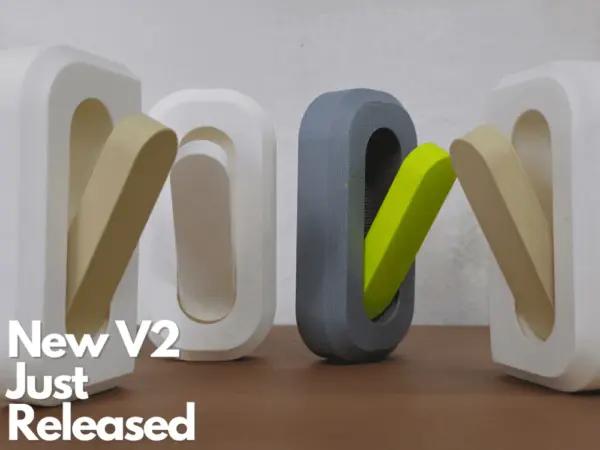
Sometimes the cleverest maker projects don’t need a single wire — just a good design and a well-tuned 3D printer. That’s the spirit behind FlexiHook, a foldable coat hook that comes off the print bed ready to use, hinge and all.
What is FlexiHook?
FlexiHook is a 3D-printable coat hook designed by maker Robota and shared on MakerWorld. The whole thing prints as a single object: a wall-mountable backing piece and a peg that pivots out when you need to hang something, then folds flush against the wall when you don’t. With the peg tucked away, it doubles as a low-profile decorative panel — a nice touch for tidy hallways, behind doors, or in small apartments where every protrusion gets bumped.
It’s the kind of design that punches above its weight: zero hardware, zero assembly, and yet it actually solves a small everyday problem. You print it, screw or stick it to the wall, and you’re done.
How the print-in-place hinge works
The clever bit is the articulated joint. Print-in-place mechanisms rely on the slicer leaving a tiny clearance — usually around 0.2 to 0.4 mm — between two surfaces that need to move past each other. After the print cools, you wiggle the joint loose and end up with a working pivot, no glue, screws, or post-processing required. It’s the same technique behind those satisfying flexi-dragons and articulated keychains, just applied to something a lot more practical. STL and 3MF files are up on MakerWorld for anyone who wants to try it.
Build it yourself
Almost any FDM printer will handle this — PLA in your color of choice prints fine, and no supports are required. If you’re a maker who likes to combine 3D prints with electronics, the same single-piece-articulation idea is brilliant for designing custom enclosures, panel mounts, and project brackets for boards like the Arduino Nano, Raspberry Pi Pico, or ESP32. Hunting for boards, jumper wires, or other parts for your next build? Browse the catalog at Circuit.Rocks.
FAQs
- Will it hold a heavy winter coat? A standard PLA print should handle a coat or jacket fine. For heavier loads, scale the model up slightly in your slicer or print it in PETG for extra toughness.
- Do I need supports to print this? No. The model is designed to print flat with the hinge built in — supports would fuse the joint and ruin the pivot.
- What will I learn by printing a hinge like this? You’ll get hands-on experience with print-in-place tolerances, cooling settings, and how slicer clearance values affect moving parts. It’s an ideal first step toward designing your own articulated prints.
