
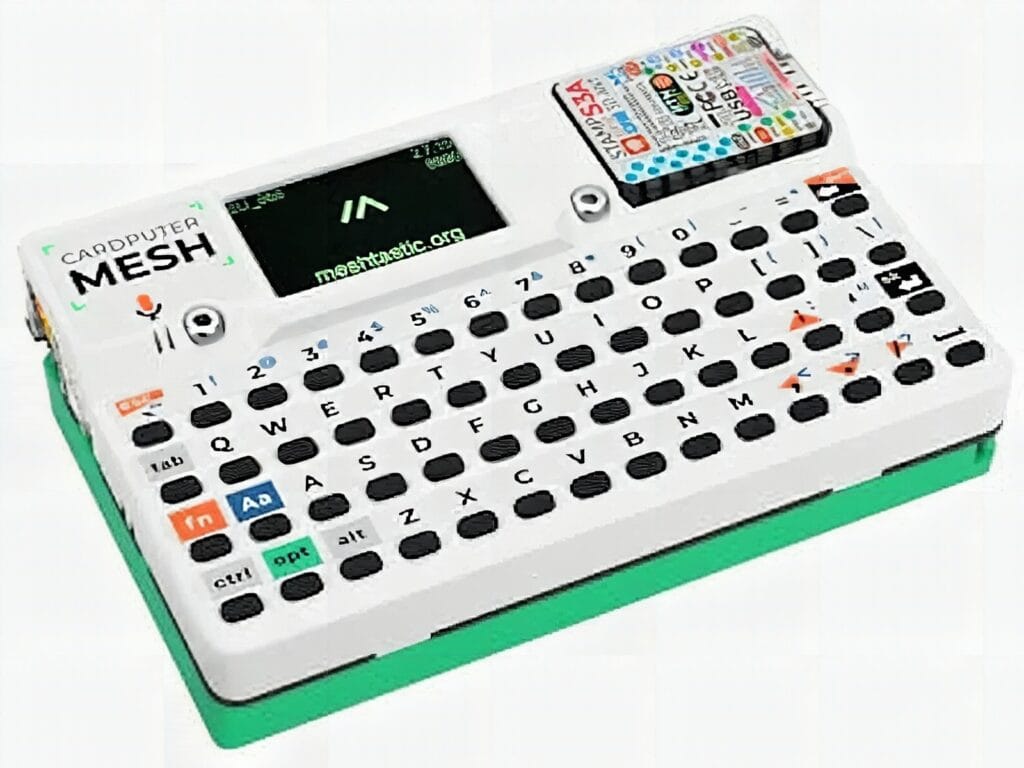
Cell coverage is great until it isn’t. The moment you step into a deep canyon, hike beyond the last bar, or roll into a power outage, that pocket supercomputer turns into an expensive flashlight. M5Stack’s new Cardputer Mesh Kit is a tiny, $48 answer to that problem.
What’s in the kit
At its heart is the Cardputer-Adv, a card-sized programmable terminal built on the ESP32-S3. It pairs a 1.14-inch LCD with a 56-key thumb keyboard, and packs in a battery, speaker, microphone, and a 3.5mm jack so you can actually use it as a stand-alone communicator. Snap on the Cap LoRa-1262 expansion and you suddenly have long-range mesh networking and worldwide satellite positioning crammed into something the size of a credit card.
The radio and GNSS bits
The expansion module rides on a Semtech SX1262 LoRa transceiver capable of around +22 dBm output with sensitivity near -147 dBm, which in practical terms means kilometer-scale links between handhelds depending on terrain. Stack a few of these together and messages can hop from device to device, no cell tower required. The same module hides an AT6668 multi-constellation GNSS receiver, so you get GPS, GLONASS, Galileo, and BeiDou fixes accurate to roughly 1.5 meters. It ships preloaded with Meshtastic firmware, so you can be chatting with nearby nodes in minutes, then dive into Arduino, ESP-IDF, or UiFlow2 to build your own apps on top.
Why makers will love it
Grove ports, an expansion bus, magnetic backing, and LEGO-compatible mounting holes mean it slots into almost any project. Think trail-tracking beacons, bike-to-bike messaging, drone telemetry relays, or a backup comms node for your local maker space.
Build it yourself
Want to roll your own version before the kit ships your way? You can prototype the same idea with parts you can grab right now from Circuit.Rocks. Pair an ESP32 dev board with a SX1262-based LoRa module, snap on a small OLED for status, and add a NEO-6M or NEO-M8N GPS module for positioning. A Raspberry Pi Pico works nicely as a low-power companion node, and a DHT11 or BME280 lets your beacons pull double duty as remote weather stations.
- ESP32 or ESP32-S3 dev board
- SX1262 / SX1276 LoRa module
- NEO-6M GPS module
- 0.96″ OLED display
- LiPo cell + TP4056 charger
Off-grid messaging used to mean expensive satellite hardware. With $48 worth of LoRa and a few weekend evenings, you can join the mesh on your own terms.
