
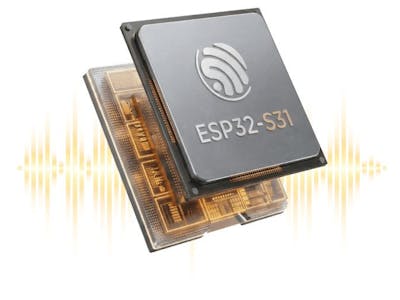
Espressif just pulled the wraps off two fresh development kits aimed at one of its most ambitious chips yet: the dual-core RISC-V ESP32-S31. If you’ve been waiting for a board that blends heavy IoT muscle with edge AI capability, this pair is worth a long look.
What’s the big deal with the ESP32-S31?
The new chip pairs two RISC-V cores in a heterogeneous setup. One runs up to 320 MHz for performance-hungry workloads, while the other sips power for everyday microcontroller chores. Espressif is pitching it at advanced IoT, machine learning inference, computer vision, and smart audio — all from a single chip with 60 GPIOs to spare.
On the radio side you get Wi-Fi 6 on 2.4 GHz, Bluetooth 5.4 Classic and Low Energy, plus an 802.15.4 radio with Thread and Zigbee. There’s even an integrated gigabit Ethernet MAC, which is rare for an ESP32. RAM-wise, you’re looking at 512 KB of on-chip SRAM and an eight-bit 250 MHz DDR bus for external PSRAM. One core also packs a 128-bit data path with SIMD for parallel number crunching.
CoreBoard vs. Korvo: pick your flavour
The ESP32-S31-Function-CoreBoard-1 is the workhorse. It carries 16 MB of PSRAM, a choice of 8, 16, or 32 MB of flash, an on-board microphone, a mono audio codec with amplified speaker output, wired Ethernet, USB 2.0 High Speed Type-A and Full Speed Type-C ports, a 40-pin GPIO header, a built-in current measurement header, and a user-addressable RGB LED. Ideal if you want to prototype anything from sensor hubs to networked controllers.
The ESP32-S31-Korvo-1 trades Ethernet for human-machine interface (HMI) gear. The same module — this time with 16 MB of flash — is wired to an Omnivision OV3660 camera, a 4.3-inch 800×480 LCD, two independent speaker outputs, two analog microphones, four user buttons, an RGB LED, a microSD slot, and USB Type-A and Type-C. It’s basically a ready-made smart display reference design.
Build it yourself
Want to hack on one of these straight away? You’ll need the ESP32-S31 module itself, and depending on which board you’re cloning: an Omnivision OV3660 camera module, a 4.3-inch 800×480 LCD panel, analog microphones, a mono audio codec and speaker driver, a microSD card slot, and USB Type-A plus Type-C ports. Pricing and general availability haven’t been confirmed yet, but Espressif’s documentation pages for the CoreBoard and Korvo are already live.
Frequently Asked Questions
What makes the ESP32-S31 different from earlier ESP32 chips?
It uses a dual-heterogeneous-core RISC-V design (one core up to 320 MHz, one low-power), adds Wi-Fi 6, Bluetooth 5.4, 802.15.4 for Thread/Zigbee, gigabit Ethernet MAC, and a 128-bit SIMD data path aimed at edge AI workloads.
How do the CoreBoard and Korvo differ in hardware?
The CoreBoard ships with 16 MB PSRAM, configurable flash, wired Ethernet, a 40-pin GPIO header, and a mono speaker output. The Korvo drops Ethernet and instead pairs the module with an OV3660 camera, a 4.3-inch 800×480 LCD, two speaker outputs, two mics, and a microSD slot for HMI projects.
What will I learn if I build with one of these boards?
You’ll get hands-on with dual-core RISC-V firmware, multi-protocol wireless (Wi-Fi 6, BLE, Thread/Zigbee), edge AI inference using SIMD instructions, and either networked sensor design on the CoreBoard or camera, audio, and touchscreen HMI development on the Korvo.
