
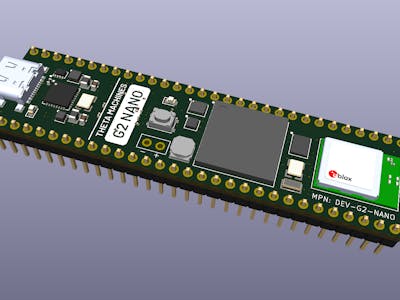
What if a development board could be as friendly as an Arduino, yet powerful enough to drive industrial-grade robots? That is exactly the gap the new G2 Nano sets out to close.
Most hobby boards handle simple robot builds with ease, but they hit a wall once a project demands tight, simultaneous control of several motors. Embedded systems engineer Ryan Strace noticed that the custom controllers built for these complex machines tend to look remarkably alike, with motor coordination as the recurring headache. Rather than reinventing that hardware on every project, he designed a single accessible platform to handle it, and the G2 Nano is the result.
Precise motor control usually leans on closed-loop techniques like PID, but real-world gremlins such as integrator windup, sensor noise, mechanical saturation, and phase delay can all degrade performance. Robots also need smooth multi-axis motion with managed acceleration to avoid jerky, stressful movement, plus solid fault handling so an unexpected state does not wreck expensive parts. Strace is tackling all of this with a low-cost motion-control IC he is developing, and the G2 Nano is the high-performance platform built to prove out that future chip.
What’s under the hood
- Processor: NXP Arm Cortex-M7 clocked at a brisk 1 GHz
- Wireless: u-blox MAYA-W1 module with dual-band Wi-Fi and Bluetooth
- Motion sensing: six-axis IMU (3-axis accelerometer plus 3-axis gyroscope) and a dedicated magnetometer for compass heading
- Form factor: just 0.8 by 3 inches, breadboard-friendly, on a six-layer PCB stackup for clean high-speed signals
On the software side, the board targets native micro-ROS and the Zephyr real-time operating system, with planned MicroPython support so you can prototype in Python without paying the usual speed penalty, thanks to that unusually high clock. Every design file and document is open-source and published on GitHub.
Build it yourself
If you want to follow along, the core ingredients are clear: an NXP Cortex-M7 at its heart, a u-blox MAYA-W1 for connectivity, and a six-axis IMU paired with a magnetometer for spatial awareness. Pair those with micro-ROS or Zephyr, lean on the open-source design files on GitHub as your reference, and you have a serious motion-control playground that still fits in the palm of your hand on a breadboard.
Frequently Asked Questions
What processor powers the G2 Nano?
It runs an NXP Arm Cortex-M7 at 1 GHz, making it far faster than typical hobby boards and well suited to coordinating multiple motors in real time.
What sensors and wireless connectivity does the G2 Nano include?
It carries a six-axis IMU (3-axis accelerometer and 3-axis gyroscope) plus a dedicated magnetometer for compass heading, and a u-blox MAYA-W1 module for dual-band Wi-Fi and Bluetooth.
What will I learn if I build with this board?
You will get hands-on with closed-loop motor control, multi-axis motion profiles, and fault handling, plus practical experience with micro-ROS, the Zephyr RTOS, and MicroPython on a fast Cortex-M7.
