
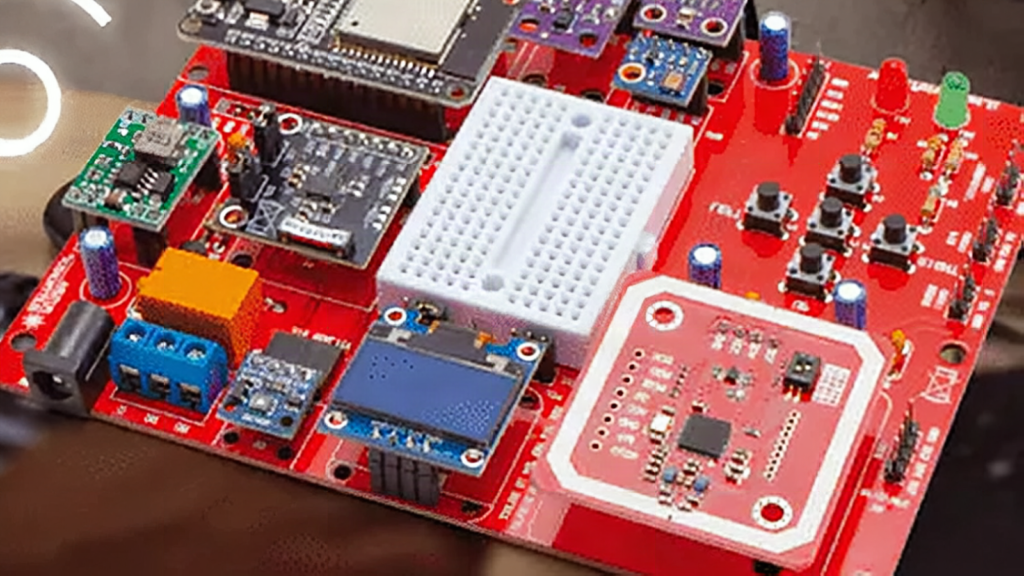
One board, one OLED, and a drawer of plug-in breakout modules is turning into a quiet trend: a single ESP32 demo platform that lets you swap sensors instead of rewiring a breadboard every time. Open Electronics just posted five more Arduino examples for its ESP32 demoboard series, and each one teaches a different sensor interface.
Five sensors, one display
The new batch, covered by Adafruit and written up at Open Electronics, starts with an APDS-9960 that reads hand gestures from roughly 10 to 20 cm away and prints the swipe direction on the OLED. Next comes an AMS AS3935 lightning detector that counts strikes and estimates distance up to 40 km. A PN532 NFC reader/writer with a PCB antenna reads tag IDs to the serial port and the screen. A Bosch BMP280 reports temperature, pressure (300 to 1100 hPa) and altitude. The last sketch wires a PIR motion sensor to an external connector, so the on-board relay closes and an alarm message appears while the output is active.
What each example teaches
- APDS-9960 and BMP280 are I2C parts, so you practice SDA/SCL wiring, address scanning and library installs.
- The AS3935 and PN532 can run over I2C or SPI, which makes them a good place to learn why one pin strap changes the whole bus.
- The PIR example is plain digital input plus a relay output, the simplest path to a working alarm.
A gotcha with PIR modules: most need 30 to 60 seconds to settle after power-up, so a relay that clicks at boot is normal, not a bug. For the BMP280, check whether your breakout answers at 0x76 or 0x77 before blaming the library.
What to try next
The series has a third and final part planned, so you have time to build the first five. For a school lab, split the sensors across groups and have each team present their reading on the shared board. For a thesis, pair the BMP280 altitude data with the AS3935 strike count and log both over MQTT. Start with the BMP280: a breakout costs around PHP 150 to 250 at circuit.rocks, and the sketch is short enough to read in one sitting.
Frequently Asked Questions
Which sensors does the ESP32 demoboard series use?
The latest batch uses an APDS-9960 gesture sensor, an AS3935 lightning detector, a PN532 NFC reader, a BMP280 pressure sensor and a PIR motion detector, all shown on the board’s OLED.
Do I need to solder to try these examples?
The demoboard takes plug-in breakout modules, so most examples need no soldering. You will need the Arduino IDE, the matching sensor libraries and a USB cable.
What will I learn if I build this?
You learn I2C and SPI wiring, address scanning, reading sensor libraries and driving a relay from a digital input. Those basics cover most thesis-level sensing and alarm projects.
