
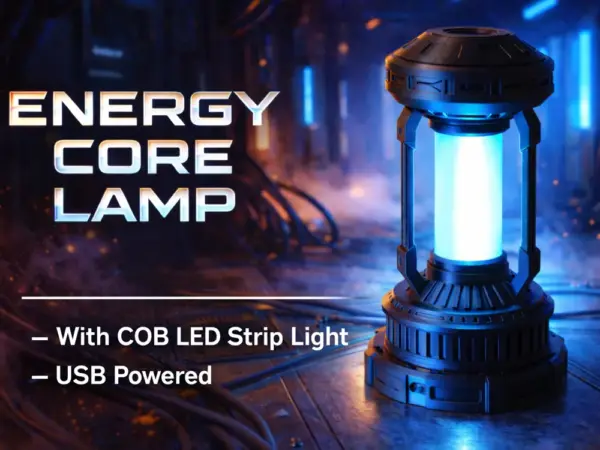
What if your desk lamp looked like it had been pulled straight out of a sci-fi spaceship? Maker katogab10 designed exactly that — the Energy Core Lamp, a 3D-printed light fixture that brings the look of a futuristic power core right onto your workspace.
A Reactor for Your Desk
The build pairs a fully 3D-printed housing with a modular electronics layout, giving you a clean, polished result without exposed wiring or visible mounting hardware. It works equally well as a desk lamp, an ambient mood light, or a display centerpiece for anyone who loves cyberpunk, dieselpunk, or any other “punk” flavor of decor.
What makes this design stand out is how the glow is produced. Instead of a row of individual diodes peeking through a diffuser, the Energy Core Lamp uses a COB LED strip — a continuous chip-on-board strip of light-emitting elements packed tightly together — tucked inside a translucent PLA tube. The result is a smooth, even glow with no visible hot spots and no LED dotting through the housing.
What’s Inside the Build
The hardware list is refreshingly compact. The lamp’s outer body is printed in standard PLA, while the central glowing tube uses translucent PLA so light can pass through evenly. A COB LED strip sits inside that tube, and the modular electronics handle power. Because the strip is hidden behind translucent plastic, even budget COB LEDs end up looking professional once installed.
Build It Yourself
Want one for your own desk? You’ll need a 3D printer, a roll of translucent PLA filament for the diffuser tube, a roll of standard PLA in your color of choice for the outer housing, and a COB LED strip sized to fit the core. Grab the STL files from the maker’s MakerWorld page, slice them, and you’ll have a glowing reactor sitting on your desk in an evening.
Why COB Beats Traditional LED Strips Here
Traditional LED strips work fine for under-cabinet lighting or accent work, but in a transparent or translucent enclosure they tend to look like a string of bright dots rather than a continuous bar of light. COB strips fix that by using dozens of small emitters per centimeter sitting under a single phosphor coating, so the light blends together before it ever leaves the strip. For a build like this lamp, where the LEDs are meant to look like a single glowing column of energy, that difference is what sells the effect.
It’s a great example of how 3D printing and a smart LED choice can turn a handful of inexpensive parts into something that genuinely looks like prop art.
Frequently Asked Questions
What kind of LED does the Energy Core Lamp use?
It uses a COB (chip-on-board) LED strip rather than discrete LEDs. COB strips pack tiny diodes tightly together so the light looks continuous, which is what gives the lamp its smooth, dotless glow when it shines through the translucent PLA tube.
What 3D printing materials do I need to build this lamp?
You’ll need translucent PLA for the central diffuser tube (that’s the part that actually glows), and standard PLA in any color you like for the outer housing. The translucent filament is what lets the COB LED light spread evenly without visible hot spots.
What will I learn if I build this?
You’ll get hands-on practice with multi-part 3D printing, working with translucent filament, and wiring a COB LED strip to a power source. It’s a friendly intro to combining electronics with custom 3D-printed enclosures, a skill that carries over to props, lamps, robot housings, and beyond.
