
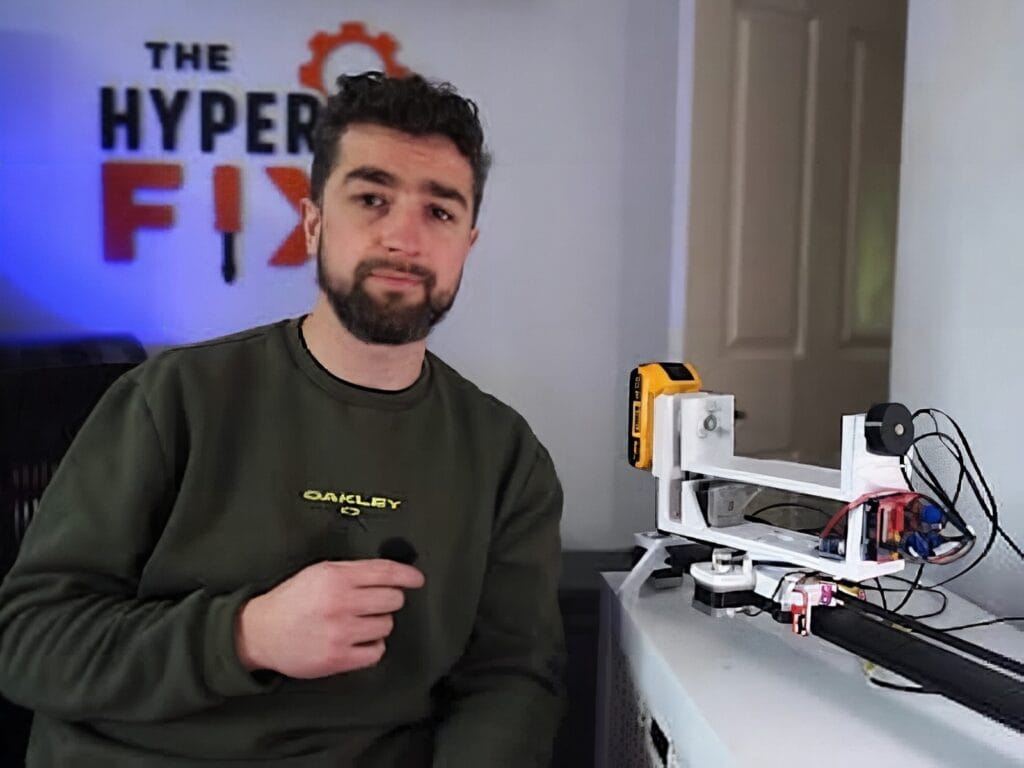
Cinematic shots don’t have to cost a fortune. Maker TheHyperFix proved that by turning a retired 3D printer into a fully motorized, three-axis camera slider — and the brain of the whole thing is a humble Arduino UNO R3.
Faced with the eye-watering price of a brand-name motorized slider, TheHyperFix took stock of what was already on the workbench: one dusty, retired 3D printer. Between its aluminum extrusions, stepper motors, lead screws, and odd hardware, the donor machine already had nearly every mechanical piece a slider rig could ask for. The original printer’s X, Y, and Z axes were repurposed into three motion axes for the camera — linear travel, pan, and tilt — a one-to-one match that made the conversion almost too neat to refuse.
It wasn’t a perfectly smooth build. A stray short cooked the printer’s old controller mid-project, forcing a budget rethink. The replacement turned out to be more capable than the original. After swapping in better microstepping drivers and reinforcing a few 3D-printed brackets, the rebuilt rig started capturing the kind of buttery, cinematic motion that normally costs hundreds of dollars off the shelf.
What’s under the hood
At the core of the rebuild sits an Arduino UNO R3 paired with a CNC shield. The CNC shield is a smart choice here because it was originally designed to drive three-axis hobby CNC machines — exactly the X / pan / tilt arrangement the slider needs — so the three stepper motor driver modules slot straight in with no custom wiring. The aluminum extrusion from the printer frame becomes the slider rail, the salvaged stepper motors handle motion, and custom 3D-printed brackets hold the camera and link the motors to the moving carriage.
Build it yourself
Want to put together your own? The parts list is short and friendly to a hobbyist budget:
- Arduino UNO R3 — runs the motion code
- CNC shield — hosts three stepper driver modules out of the box
- Stepper motor driver modules — go for ones with finer microstepping for smoother shots
- Stepper motors — easy to salvage from any retired 3D printer
- Aluminum extrusion plus custom 3D-printed brackets for the rail and camera mount
A dead 3D printer is by far the cheapest source for the motors, extrusion, and assorted hardware. If you don’t have one to cannibalize, buying the parts individually still lands well under the price of a commercial motorized slider — and you end up with a rig you fully understand and can tweak forever.
Frequently Asked Questions
What controller runs this DIY camera slider?
The slider uses an Arduino UNO R3 paired with a CNC shield, which hosts three stepper motor driver modules — one each for linear travel, pan, and tilt.
Can I really build a motorized camera slider from old 3D printer parts?
Yes. The aluminum extrusion, stepper motors, and most of the mechanical bits inside a retired FDM 3D printer line up almost perfectly with what a three-axis slider needs. Add a CNC shield, an Arduino UNO R3, and some 3D-printed brackets, and you have a working rig.
What will I learn if I build this?
You’ll get hands-on practice with stepper motors and microstepping, Arduino-based motion control, CNC shield wiring, and mechanical design with aluminum extrusion. It’s also a great intro to smooth motion, acceleration curves, and repurposing existing hardware into something new.
