
Looking for a microcontroller board that pulls more weight than a basic Pico without leaving the familiar Raspberry Pi ecosystem? A new wave of RP2350-based boards has landed, and they pack everything from AMOLED touchscreens to Ethernet jacks.
The RP2350 is the same chip that powers Raspberry Pi Pico 2: dual Arm Cortex-M33 cores at 150MHz, 520KB of on-chip SRAM, and twelve PIO state machines. Third-party makers have taken that silicon and built it into boards that target everything from tiny wearables to robotics rigs. There are actually two flavours of the chip — the standard RP2350A and the larger RP2350B, which adds 16 extra GPIOs and five more ADC channels for projects that need more pins to play with.
The boards that caught our eye
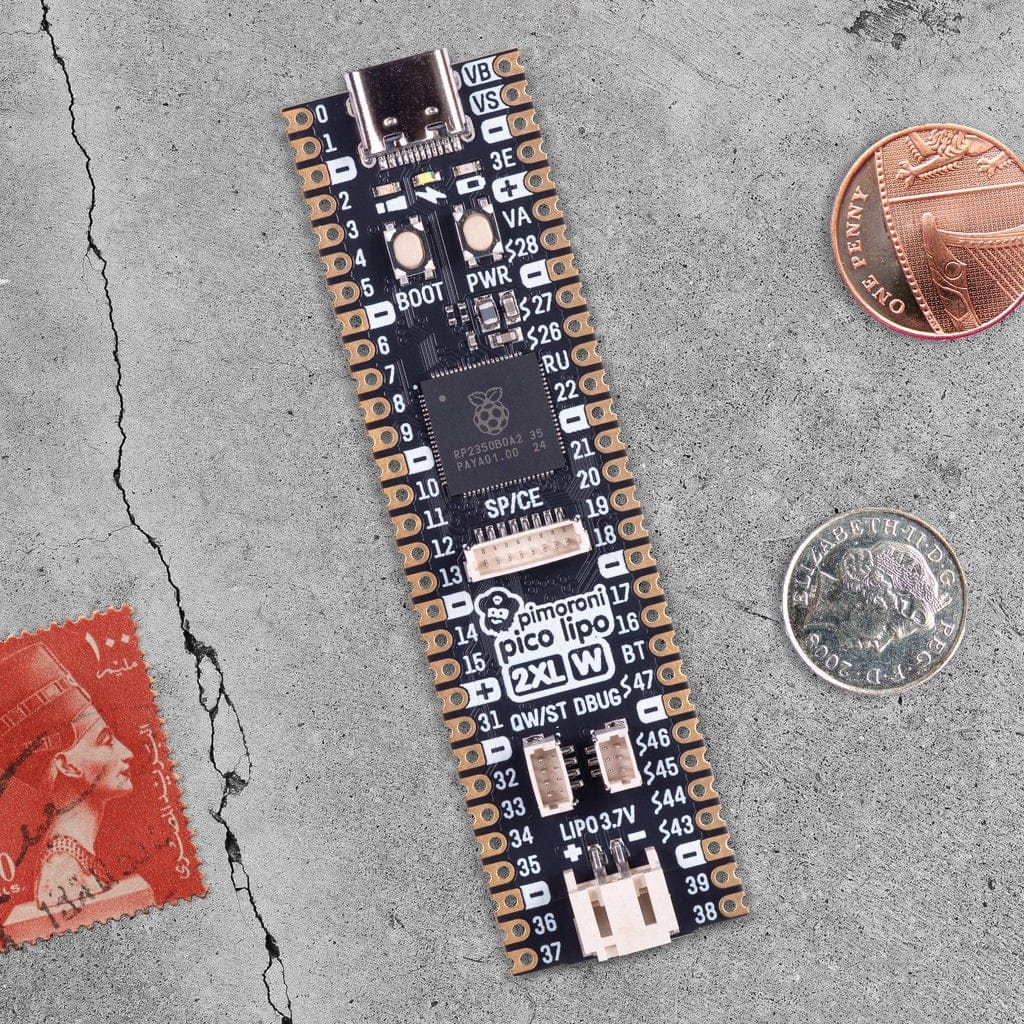
On the higher end, Pimoroni’s Pico LiPo 2 XL W uses the RP2350B with all 20 extra pins broken out, bumps memory to 8MB of RAM and 16MB of flash, and adds on-board LiPo charging plus a Raspberry Pi Radio Module 2 for Wi-Fi and Bluetooth. The Inventor 2350 W goes the robotics route with headers for six servos, an on-board motor driver, two Qwiic/STEMMA QT ports for sensors, NeoPixels and even a small audio output — built around a soldered-down Pico 2 W.
If you want a display, Waveshare’s RP2350 1.43-inch AMOLED Round Dev Board ships with a 466 × 466 capacitive touchscreen, a six-axis IMU, and an RTC, making it a credible base for a wearable or pocket tracker. The Plasma 2350 W from Pimoroni is built for addressable LED strings (WS2812/NeoPixel or APA102/DotStar) with screw terminals and Wi-Fi for IoT light shows. Need something pocket-sized? The Tiny 2350 measures just 22.9 × 18mm — about the size of a postage stamp — but still squeezes in 12 GPIOs, a Qwiic/STEMMA QT port, and 4MB of QSPI flash. And for wired networking, the WIZnet W6300-EVB-Pico2 bolts a hardwired TCP/IP stack onto the RP2350, with IPv4 and IPv6 support, in a Pico-compatible pinout.
Build it yourself
Most of these boards lean on a familiar parts list: a Raspberry Pi Pico 2 (or Pico 2 W for wireless), Qwiic/STEMMA QT sensor modules, NeoPixel or DotStar LED strips, a LiPo or Li-ion battery for portable builds, and USB-C cables for power and flashing. Add servos and DC motors if you’re going down the Inventor 2350 W path, or grab an Ethernet cable if you’re trying the WIZnet board for a low-power web server or IoT logger.
Whether you code in MicroPython, CircuitPython, or C/C++, the RP2350 keeps the learning curve gentle while opening doors to far more ambitious projects than the original Pico ever could.
Frequently Asked Questions
What is the difference between the RP2350A and RP2350B chips on these boards?
Both share the same dual Cortex-M33 cores and 520KB of SRAM, but RP2350B adds 20 more pin connections — 16 extra GPIOs and five additional ADC channels. The Pimoroni Pico LiPo 2 XL W uses RP2350B to break out those extra pins, while smaller boards like the Tiny 2350 stick with RP2350A.
Which board is best if I want to control NeoPixel LED strings over Wi-Fi?
What will I learn if I build a project with one of these boards?
You’ll pick up hands-on experience with microcontroller programming in MicroPython or C/C++, GPIO and ADC fundamentals, common interfaces like I2C, SPI, UART, and Qwiic/STEMMA QT, and — depending on the board — battery power management, servo and motor control, touchscreen GUIs with LVGL, addressable LED protocols, or Ethernet/TCP-IP networking on an embedded device.
