
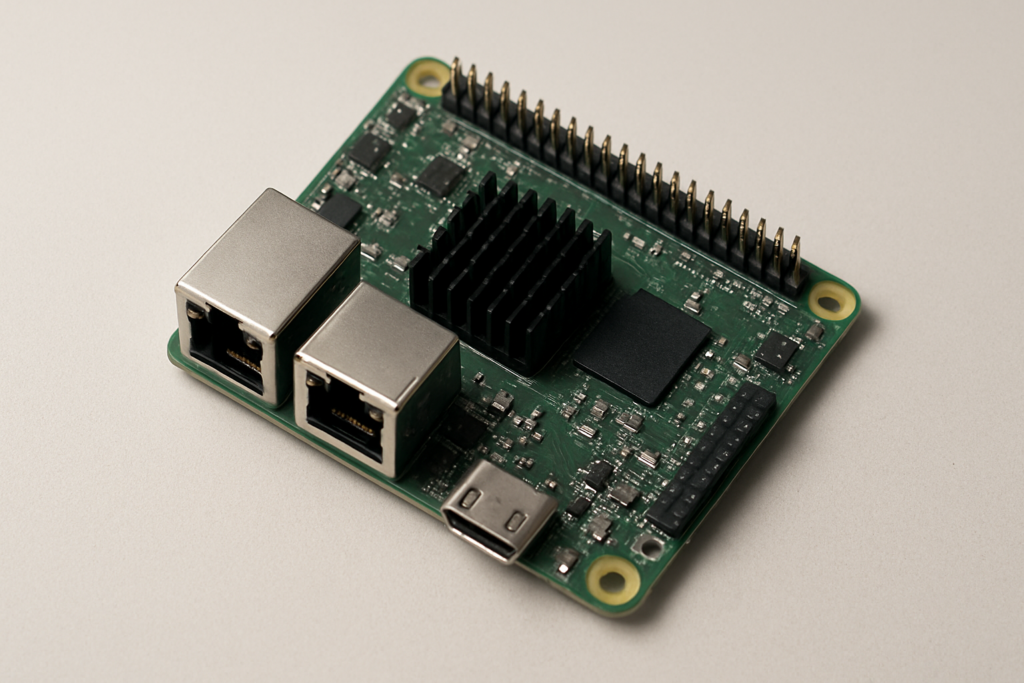
The gap between hobbyist single-board computers and the hardware that runs a factory floor keeps getting smaller, and that trend is exactly where the DEBIX T62P-01 wants to live. Boards like the Raspberry Pi are brilliant for learning and prototyping, but a production line, a robot arm, or an outdoor sensor node needs deterministic timing, wide-temperature tolerance, and security that survives real deployment. This new edge computer is built for that harder league.
What DEBIX packed onto the board
At the heart of the T62P-01 sits a Texas Instruments Sitara AM62P. It pairs four Cortex-A53 application cores clocked up to 1.4 GHz with two dedicated Cortex-R5F real-time cores running up to 800 MHz. That split lets Linux or Android drive the user interface while the isolated R5F cores handle bare-metal or FreeRTOS code for motor control and industrial automation. You can spec it with 2, 4, or 8 GB of LPDDR4, and connectivity spans dual Gigabit Ethernet with Time-Sensitive Networking, Wi-Fi 6, and Bluetooth 5.4. Display and camera work is covered too, with LVDS or MIPI DSI output up to 3840 x 1080 and a four-lane MIPI CSI input for sensors up to 13 megapixels.
The real-time takeaway
The interesting engineering lesson here is heterogeneous computing: instead of forcing one processor to juggle a full OS and microsecond-accurate control, the design hands each job to the core built for it. A few standout details make it practical:
- A USB-C debug port exposing three independent UART channels, one for Linux and one for each R5F core.
- Hardware secure boot with a Root of Trust, Arm TrustZone, and a crypto module for AES, SHA, and true random numbers.
- A 40-pin header breaking out UART, SPI, I2C, CAN, PWM, and GPIO, plus optional -40 to 85 degrees C operation.
What to try next
You do not need a factory to explore these ideas. Grab any dual-core-capable board you already own and try splitting a project so one core polls a sensor on a strict schedule while the other logs data or serves a dashboard. Experimenting with FreeRTOS on a spare ESP32 or RP2040 teaches the same real-time discipline that industrial boards like the DEBIX rely on, and it is a strong portfolio piece for any embedded systems thesis.
Frequently Asked Questions
Why does the DEBIX T62P-01 have separate real-time cores?
The two Cortex-R5F cores run isolated bare-metal or FreeRTOS code for time-critical jobs like motor control, while the four Cortex-A53 cores handle Linux or Android. Splitting the workload keeps timing deterministic instead of letting a busy OS introduce jitter.
What connectivity and expansion does the board offer?
It brings dual Gigabit Ethernet with Time-Sensitive Networking, Wi-Fi 6, and Bluetooth 5.4, plus a 40-pin header exposing UART, SPI, I2C, CAN, PWM, and GPIO. A USB-C debug port even splits out three independent UART channels for multicore debugging.
What will I learn if I build something like this?
You will pick up heterogeneous computing and real-time design: how to assign a strict-timing task to one core while another runs a full OS. Practicing with FreeRTOS on an ESP32 or RP2040 builds the same embedded discipline used in industrial automation, robotics, and IoT gateways.
