
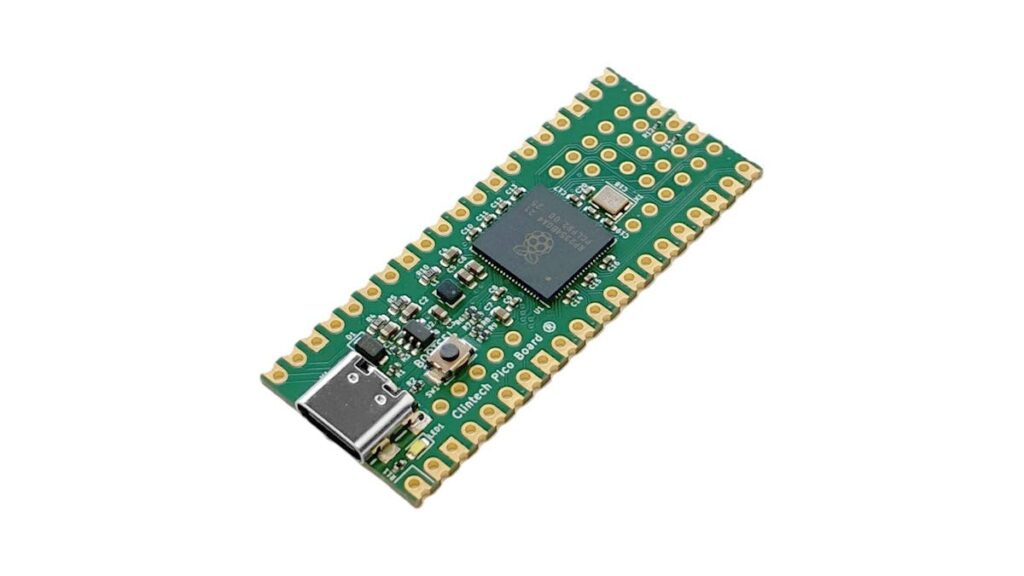
You know the moment. The build is finally coming together, you count your free pins, and the display, the sensors, and the motor driver have already eaten every last one. Anyone who has pushed a Raspberry Pi Pico 2 past a simple blink sketch has smacked into this wall. Clintech’s new Pico Board is built for exactly that moment.
The standard Pico 2 breaks out 26 GPIO pins, which is plenty for a first project but tight once peripherals start stacking up. The catch is that the RP2350 silicon underneath can actually drive up to 48 GPIOs, and the regular board simply never exposes them all. Clintech’s Pico Board keeps the familiar Pico 2 shape and pinout but routes every one of those 48 pins to the edge, so you get the chip’s full I/O without jumping to a bigger, unfamiliar platform.
Because it holds a 1:1 footprint with the original, it drops straight into hardware you have already designed around the Pico. That makes it a low-friction upgrade instead of a redesign, which is a lifesaver when a thesis prototype outgrows its pin budget the week before the demo.
What’s under the hood
The board is built on Raspberry Pi’s RP2354B, the in-package-flash member of the RP2350 family. The spec sheet leaves a lot of room to experiment:
- Dual Arm Cortex-M33 cores and dual Hazard3 RISC-V cores, each running up to 150 MHz. Boot two Arm cores, two RISC-V cores, or a hybrid of one from each.
- 520 KB of SRAM plus 2 MB of onboard flash, with a QSPI breakout for up to 16 MB of external flash or PSRAM when a project needs bigger buffers.
- Three PIO blocks and 12 state machines for custom, hardware-timed protocols, which is exactly what robotics and high-speed interfaces need.
- USB-C for power and programming, a three-pin debug header, a boot button, and an onboard LED, all on a 51 x 21 mm DIP-40 board with castellated edges.
Build it yourself
Clintech open-sourced the whole thing, releasing the schematic, KiCad footprint, header files, and demo firmware, so you can study the design or fold the module straight into your own PCB through those castellated edges. The extra pins are precisely what pin-starved builds crave, whether that’s a line-following bot bristling with sensors or a classroom data logger reading a full bank of inputs at once. The board is launching soon on Crowd Supply, so sign up for notifications there to grab one when it drops.
Frequently Asked Questions
How many GPIO pins does the Clintech Pico Board expose?
All 48 GPIOs of the RP2354B, compared with the 26 broken out on a standard Raspberry Pi Pico 2, while keeping the same footprint and 1:1 pinout compatibility.
Can it run RISC-V as well as Arm?
Yes. The RP2354B carries dual Arm Cortex-M33 and dual Hazard3 RISC-V cores at up to 150 MHz, and you can run two Arm cores, two RISC-V cores, or one of each in a hybrid setup.
What will I learn if I build with this board?
You’ll get hands-on with pin planning and I/O expansion, programmable I/O (PIO) for hardware-timed protocols, and the trade-offs between Arm and RISC-V cores, practical embedded skills that carry straight into robotics and capstone projects.
