
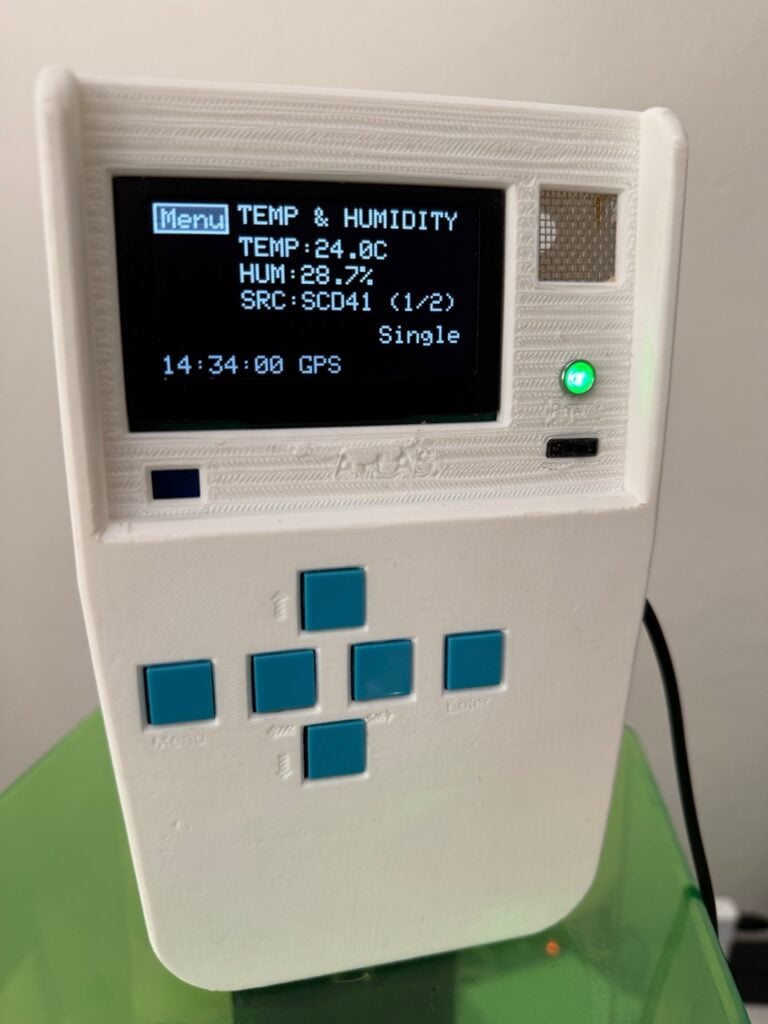
Point it at the air around you and it tells you, in plain English, whether to stay or run. That is the promise behind ATLAS, a handheld field instrument that looks like it walked straight off the set of Star Trek — except this one is real, and it runs on the Raspberry Pi RP2350.
ATLAS, short for Advanced Tactical Laboratory and Analysis System, is the work of the team at Second Robotics, who set out to build a rugged tool for explorers, engineers, and anyone heading somewhere the weather and the air cannot be trusted. Instead of dumping raw numbers on a screen, it interprets them. A cluster of pro-grade sensors feeds readings for radiation, CO₂, VOCs, temperature, humidity, light, sound, and magnetic fields into the microcontroller, which turns them into direct calls like “Safe background radiation levels” or “Storm incoming in 2 hours, 68% chance.”
That translation layer is what separates ATLAS from a pile of breakout boards. The device is built to survive drops, dust, and long days in the field, with a housing designed around real-world abuse rather than a benchtop demo.
What’s under the hood
The brain is the RP2350, Raspberry Pi’s dual-core microcontroller with hardware security features and enough headroom to poll a wide sensor array without stalling. Each sensor talks over a standard bus like I²C, so the firmware reads them in a loop, applies thresholds, and pushes plain-language alerts to the display. Because everything runs on a microcontroller rather than a full Linux board, ATLAS boots instantly and sips power — important when your nearest outlet is a two-day hike away.
Build a simpler version yourself
You do not need all eight sensors to start. Pair an RP2350 board with one I²C environmental sensor, add a small display, and write a loop that prints a readable warning when a value crosses a limit. From there you can bolt on a gas or air-quality module and grow toward the full ATLAS idea one sensor at a time.
- A Raspberry Pi RP2350-based board (Pico 2 or similar)
- An I²C environmental sensor such as a BME280, SCD41, or SGP40
- An OLED or small TFT for plain-text alerts
- A LiPo cell and a rugged enclosure to take it outdoors
Frequently Asked Questions
What sensors does the ATLAS tricorder use?
ATLAS carries pro-grade sensors for radiation, CO2, VOCs, temperature, humidity, light, sound, and magnetic fields, all read by its RP2350 microcontroller and turned into plain-English warnings.
Do I need a full Raspberry Pi computer to build one?
No. ATLAS runs on the RP2350 microcontroller, not a Linux Pi. A Pico 2 class board is enough to poll the sensors and drive a display while running on very little power.
What will I learn if I build this?
You’ll practice reading multiple I2C sensors, setting alert thresholds in firmware, managing battery power, and turning raw data into human-readable output, all core embedded skills for a capstone or thesis project.
