
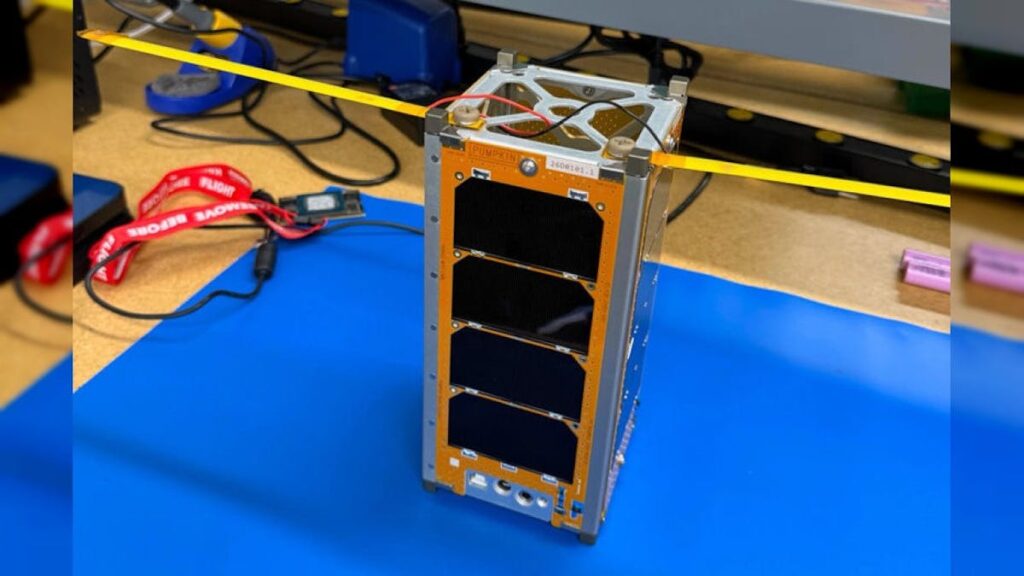
Edge AI has spent the last few years migrating off the cloud and onto tiny boards sitting on our workbenches. KENSAT pushes that trend to its logical extreme — it puts a language model in low Earth orbit. Built by Ken Chan in his home lab rather than a NASA clean room, this 2U CubeSat is scheduled to launch this fall to prove that modern edge AI hardware can operate autonomously in space.
The build itself
At the heart of KENSAT is an NVIDIA Jetson Orin Nano running a quantized TinyLlama large language model. Instead of beaming raw sensor data down for Earth-based computers to process, the satellite runs inference directly in orbit and transmits only the finished results. Surrounding that payload is a full spacecraft’s worth of custom electronics: electrical power, radio, and antenna-deployment boards, all coordinated by an always-on flight computer that keeps the whole system healthy.
Engineering around space
Space is unforgiving. Power is scarce, there is no air to carry heat away with a fan, and a single crash could leave the payload offline forever. Chan’s answer is aggressive power gating: the flight computer keeps the Jetson fully powered down until a scheduled window, boots it, sends prompts over a UART link, collects the response, then shuts it back off to save battery. Watchdog circuitry recovers from faults, while critical steps like antenna deployment and AI inference run as fault-tolerant state machines that survive brownouts and unexpected resets. Results come home over a custom 437.08 MHz UHF radio using unencrypted AX.25 packets, so amateur operators worldwide can decode the downlink with their own ground stations.
What to try next
The entire effort is open source. The GitHub repository carries flight software, Jetson payload code, SDR ground-station utilities, KiCad schematics, PCB layouts, and thermal analysis. You don’t need a rocket to learn from it: pair an RTL-SDR with a homemade antenna and practice receiving real satellite telemetry, or borrow KENSAT’s power-gating and state-machine patterns for any battery-critical build on the ground. For a thesis or capstone team, it is a full-stack blueprint spanning RF, power, embedded firmware, and applied AI in one project.
Frequently Asked Questions
What AI model does KENSAT run in orbit?
A quantized TinyLlama large language model runs on an NVIDIA Jetson Orin Nano. The satellite performs inference directly in space and transmits only the generated results back to ground stations.
How does KENSAT survive limited power and no cooling in space?
An always-on flight computer keeps the Jetson powered down until a scheduled window, then boots it, sends prompts over UART, and shuts it off again. Watchdog circuitry plus fault-tolerant state machines let it recover from brownouts and resets without fans or spare power.
What will I learn if I build a project like KENSAT?
You will touch the full embedded stack at once: custom power boards with watchdog recovery, UART communication, fault-tolerant state machines, RF design and AX.25 packet radio at 437.08 MHz, KiCad schematics and PCB layout, and running an edge AI model on constrained hardware. It is an ideal thesis or capstone scope.
