
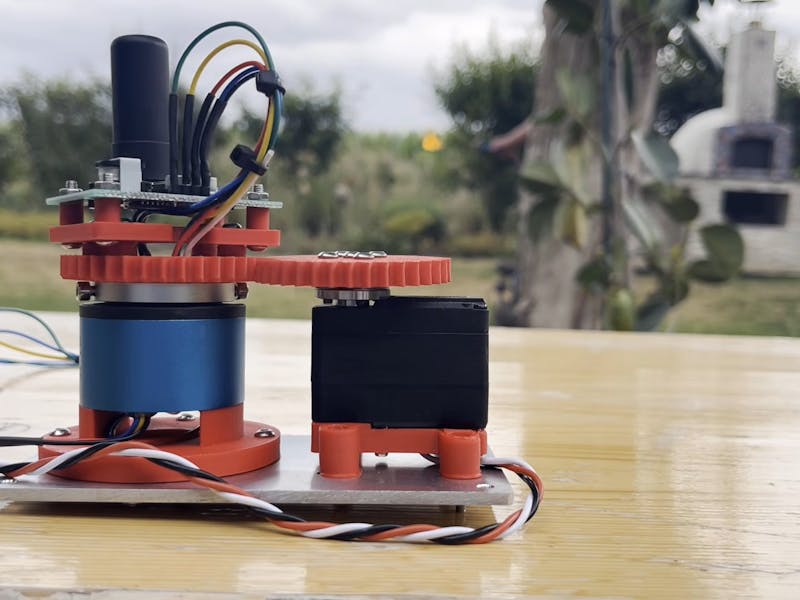
Want a flame detector that ignores sunlight and still catches a fire hiding behind brush? Here’s your shopping list: a Hamamatsu UVTRON R2868 phototube, its matching driver board, a microcontroller (an Arduino Nano or an ESP32 both do the job), a slip ring, a small gear motor, plus a few M3 screws and ball bearings. Budget a weekend and a steady soldering hand. Maker Markus Bindhammer built exactly this as an early-warning eye for an autonomous monitoring rover.
What the scanner actually does
Instead of hunting for visible light or heat, the sensor watches for ultraviolet radiation in the 185 to 260 nm band, a slice of the spectrum that flames and electrical sparks throw off. The Sun emits these wavelengths too, but Earth’s ozone layer soaks them up before they reach the ground. That makes the phototube “solar blind”: any UV it catches in that narrow window almost certainly means a real flame or spark, not a sunny afternoon. Mount the whole assembly on a spinning platform and it turns directional, not just a yes/no alarm.
The electronics, pin by pin
The R2868 needs a high-voltage supply, so it rides on a dedicated Hamamatsu driver board that steps the voltage up and conditions the output pulses. When UV strikes the tube’s cathode, electrons break loose through the photoelectric effect, avalanche through the gas, and fire off a clean digital pulse your microcontroller can read on a single GPIO pin. A CD4017 decade counter on the board works as a jumper-selectable noise filter: require three pulses before flagging a confirmed event, or set it to report every valid pulse for maximum speed. A slip ring carries power and signal between the fixed base and the rotating head so the wires never twist, and the firmware logs the platform angle at each pulse to estimate direction.
Worth building?
The numbers say yes. The bare phototube is rated to catch a lighter flame at about 8 meters. The finished rotating scanner picked up a butane torch at roughly 15 meters, and kept detecting it through dense vegetation. A resin shroud around the glass tube narrows the field of view to sharpen the direction reading. Read Bindhammer’s build notes on Hackster (https://www.hackster.io/news/sneaky-wildfires-can-t-hide-from-this-rotating-uv-flame-scanner-d2342c9eda0b), wire the driver’s output to an interrupt pin, and start with the CD4017 set to three pulses. That’s the fastest way to kill false triggers on your first outdoor test.
Frequently Asked Questions
What sensor does this flame scanner use?
A Hamamatsu UVTRON R2868 phototube. It reacts only to ultraviolet light in the 185 to 260 nm band, which flames and sparks emit but which sunlight can’t reach the ground in, so it stays ‘solar blind’ and avoids false alarms.
How does it figure out the direction of a fire?
The phototube sits on a continuously rotating platform fed by a slip ring. The microcontroller records the angle each time a UV pulse arrives, so it can estimate where the flame is rather than just detecting that one exists.
What will I learn if I build this?
You’ll practice reading digital pulses on a microcontroller interrupt pin, wiring a high-voltage driver board safely, using a CD4017 counter as a noise filter, and mounting a sensor on a rotating slip-ring assembly. It’s a solid mix of analog, digital, and mechanical skills.
