
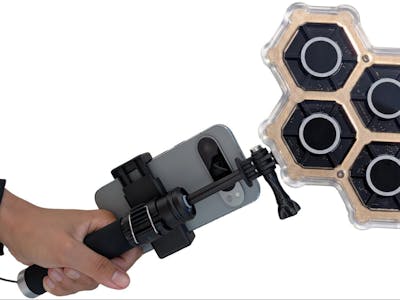
You are surrounded by radio waves right now, and you cannot see a single one of them. Wi-Fi routers, wireless cameras, drone video links, and Bluetooth beacons all pour signals into the same air, yet spotting where a transmitter physically sits has always meant renting spectrum analyzers or lab gear priced far past a student budget. That gap between hearing a signal and locating it is exactly what makes QuadRF worth a look for anyone teaching or learning RF.
QuadRF is an open source development kit that behaves like a camera for radio. Point it at a room and it renders nearby transmitters as augmented reality overlays on your phone or laptop, each source color-coded by frequency. Instead of a strength bar on a graph, you get a live map: that blob is the router in the hallway, that one is a wireless camera two desks over. Tap a source and you can route it into SDR software to decode it, or send a beamformed signal straight back at it.
What is doing the work
The magic is a coherent four-antenna array that measures tiny timing differences as a wavefront hits each element. A Lattice ECP5 FPGA crunches those differences into a 30 fps AR display, working alongside a Raspberry Pi 5 that hosts the web interface, calibration, and many SDR apps locally. The front end is a full-duplex 4×4 MIMO design covering 4.9 to 6.0 GHz, with 40 MHz of instantaneous bandwidth and up to 1 W of transmit power per chain. Heavier processing offloads over Gigabit Ethernet or USB 3.0 to tools like GNU Radio or SDRangel, so the Pi never becomes the bottleneck.
Getting your hands on one
The whole stack, hardware and software, ships under GPL licenses, which is the part that matters for a thesis or a robotics lab. You can study RF reflections, prototype beamforming code, characterize your own antennas, or give a robot a way to sense its surroundings by radio rather than light. A single unit is a standalone phased-array SDR; gang several together and the developers picture 240-element amateur arrays doing Earth-Moon-Earth bounces or a backyard radio telescope. The Crowd Supply campaign is live now with kits from $499. If you want a cheaper on-ramp first, pair a Pi 5 with a single RTL-SDR dongle and learn to read a waterfall plot before scaling up to the full array.
Frequently Asked Questions
How does QuadRF pinpoint where a signal comes from?
It uses a coherent 4×4 MIMO antenna array that measures the tiny timing differences as a radio wavefront reaches each of the four antennas. A Lattice ECP5 FPGA turns those differences into a direction, drawn as a 30 fps augmented reality overlay.
What does a QuadRF kit cost and what do you need to run it?
Kits start at $499 on Crowd Supply and include a Raspberry Pi 5, which runs the web interface and calibration locally. Heavier decoding offloads over Gigabit Ethernet or USB 3.0 to software like GNU Radio or SDRangel.
What will I learn if I build this?
You will pick up phased-array and MIMO fundamentals, beamforming math, and how coherent SDR receivers work together with an FPGA, plus practical skills in RF calibration and reading signals in tools like GNU Radio, all things that map directly onto communications and embedded coursework.
