
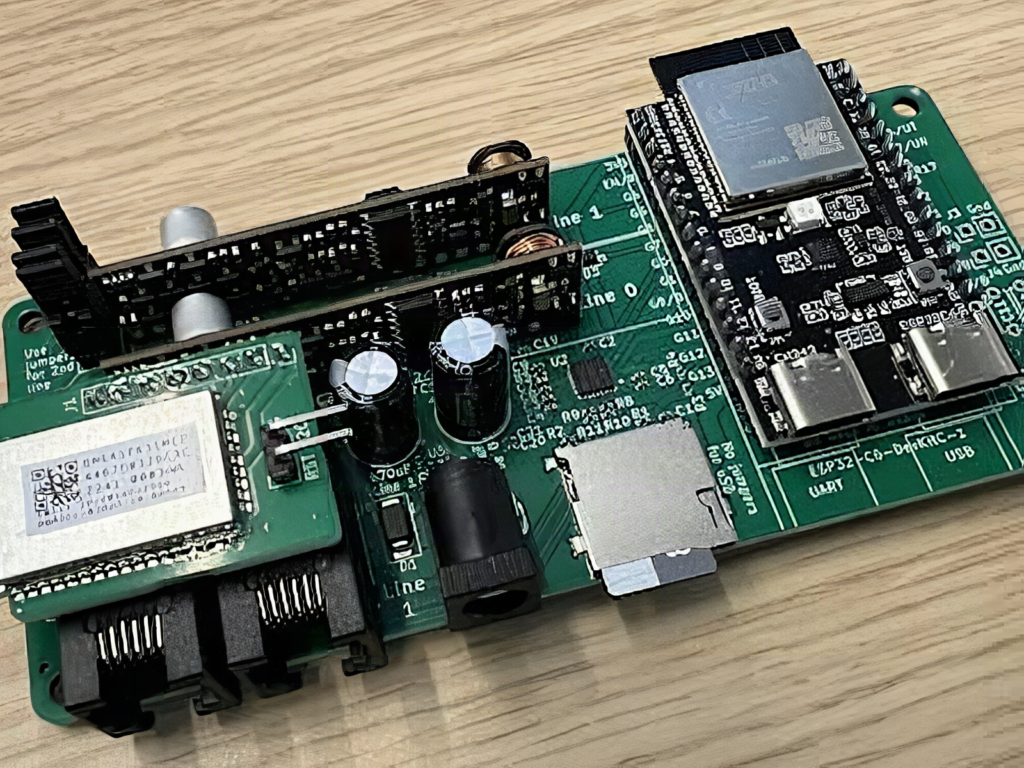
Before you touch a soldering iron, collect four things: an ESP32-C6 dev board, an ES8388 audio codec board, a Silvertel AG1171 SLIC, and a rotary or touch-tone phone that has been sitting in a closet. That short parts list is the whole recipe for Analog Redial, an open source phone system by Scott Dylewski, covered in this Hackster write-up.
What the board does
The ESP32-C6 does the thinking: it counts dial pulses, generates dial tone and ringing, runs an answering machine, and serves a web page for configuration. The AG1171 SLIC supplies what an old handset expects from a telephone exchange, namely loop current and ringing voltage. The ES8388 codec converts audio between the handset and the ESP32. Two phones wired to the same board can call each other with no Wi-Fi and no phone service at all.
Technical details worth stealing
Dial codes are the fun part. Dialing 211 records a message, 314 recites digits of pi, and other codes play clips, set timers, or switch hardware. Multiple boards can talk over a local network with VoIP, and SIP support lets them register with an Asterisk or FreePBX server. Home Assistant hooks through MQTT or webhooks are still experimental, so expect a gotcha or two. An optional BM64 Bluetooth module turns the phone into a handset for your smartphone, and incoming calls ring the original mechanical bell. The author estimates about $37 for a single-line board when ordering five, plus roughly $10 for a second line and $15 for Bluetooth.
Wrap-up for your bench
For a classroom or thesis angle, skip Bluetooth and start with the offline two-phone setup. It teaches pulse timing, tone generation, and I2S audio in one afternoon, and the KiCad files, firmware, and enclosure models are in the project’s GitHub repository linked from the source article. Order the ESP32 board first at circuit.rocks, then check your phone’s ringer: older bells may need more drive than a basic SLIC can give.
Frequently Asked Questions
What chips does Analog Redial use?
An ESP32-C6 runs dialing, tones, and the web interface, an ES8388 codec handles audio, and one or two Silvertel AG1171 SLICs supply loop current and ringing voltage to the phones.
How much does it cost to build?
The author estimates about $37 for a single-line board when ordering five, roughly $10 more for a second line, and about $15 for the optional BM64 Bluetooth module.
What will I learn if I build this?
You will practice reading rotary dial pulses, generating telephone tones, working with I2S audio codecs, reading KiCad PCB files, and setting up SIP or MQTT, all useful for ECE labs and thesis projects.
