
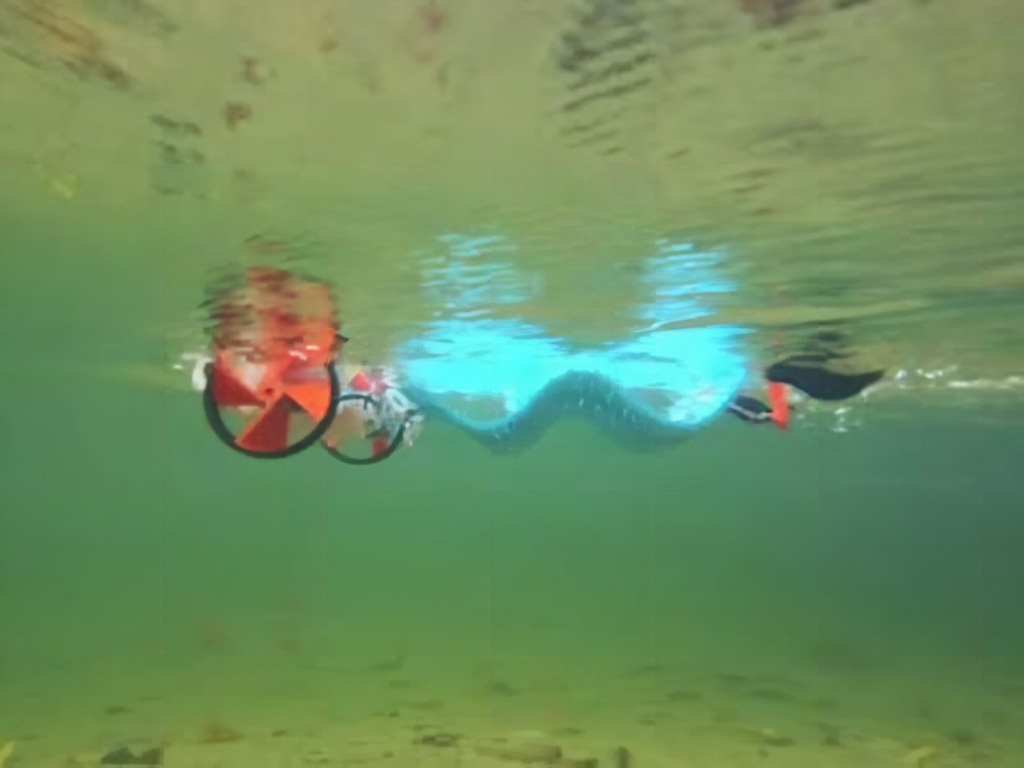
Can one motor drive a robot through a pond and then up a muddy bank? Researchers at Ben-Gurion University of the Negev say yes, and their amphibious SAWbot, covered by Hackster, is the proof.
How does one motor do the work of many?
Most swimming robots stack up servos, one per body segment, and then need code to keep every joint in step. SAWbot skips all of that. A flexible membrane is stretched between two supports on the body, and a single rotating motor turns into a smooth traveling wave along it. The wave pushes against the water the way an eel’s body does, a style biologists call anguilliform swimming. Treaded wheels on both sides handle dry ground, and two rear floats hold the wave assembly at the right depth in water, so the same machine switches environments with no hardware swap.
What do the numbers say?
In swimming tests SAWbot reached 34 cm/s with an advance ratio of 0.73, meaning it moved at 73% of the speed of its own wave. Its mechanical cost of transport ran from 0.13 at low speed to 0.37 at top speed, which puts it among the most energy-efficient swimming robots reported. The gotcha with any sealed hull is leakage, so the electronics, battery, and controller live in a closed enclosure at the front, away from the moving membrane.
Could a student team try a tabletop version?
A scaled-down experiment is realistic. A single N20 gear motor, a motor driver such as an L298N, and a PWM pin on an Arduino Uno or ESP32 are enough to spin a cam shaft at a few hundred RPM. Use a library like ESP32‘s LEDC PWM or Arduino’s analogWrite to sweep speed, then log how fast a floating chassis crosses a plastic tub. A 6 V battery pack is plenty for a first test. Seal every solder joint with heat-shrink and keep the driver board above the waterline.
Students can compare wave frequency against swim speed and plot the result, which makes a clean capstone or science fair dataset. Read the full write-up at Hackster, then pick up a gear motor and an ESP32 board at circuit.rocks to start your own cam-and-membrane prototype.
Frequently Asked Questions
How does SAWbot swim with only one motor?
The motor turns a mechanism that drives a flexible membrane into a continuous traveling wave, similar to eel swimming. The wave pushes water backward and moves the robot forward without multiple servos.
How fast and how efficient is it?
It reached 34 cm/s in swimming tests with an advance ratio of 0.73. Its mechanical cost of transport measured 0.13 at low speed and 0.37 at maximum speed.
What will I learn if I build this?
You will practice motor driver wiring, PWM speed control, waterproofing electronics, and measuring performance such as speed versus wave frequency, all useful for robotics classes and capstone projects.
