
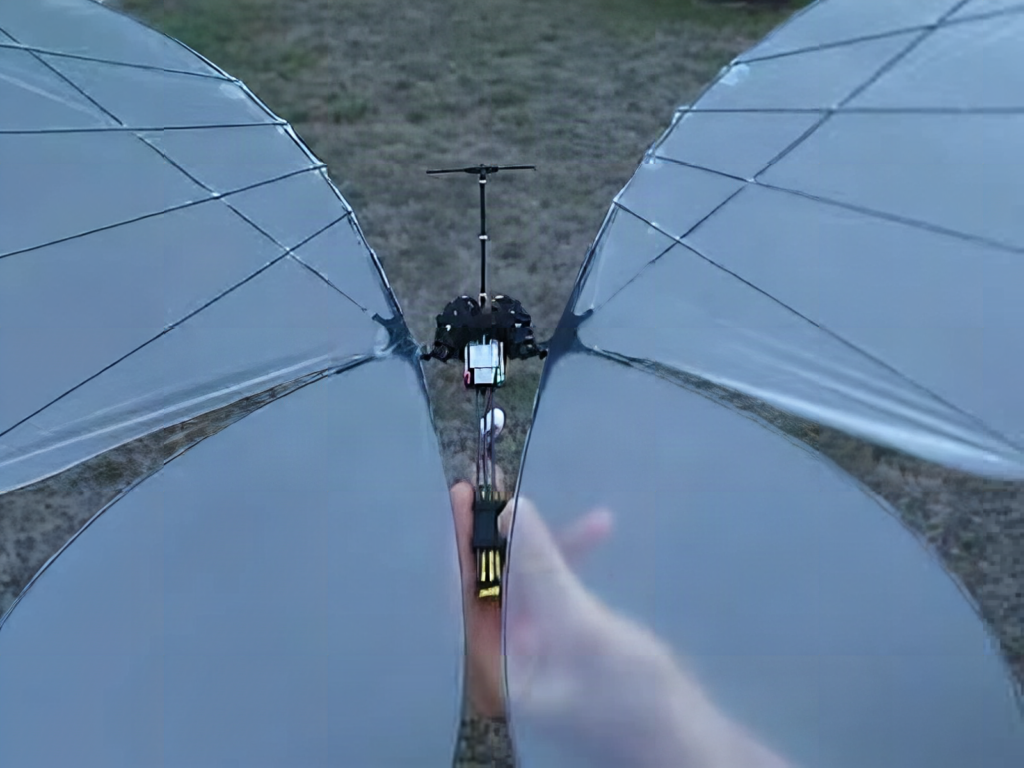
Most hobby drones cheat: spin four propellers fast enough and lift takes care of itself. Flapping wings are harder, because every beat has to produce lift and thrust at the same time, and that is why a 70 g butterfly that actually flies is worth a look for anyone teaching or learning robotics. Hackster covered the build in this write-up.
What Max Imagination built
ESP-FLUTTER is a remote-controlled ornithopter. Instead of one motor and a linkage driving both wings, it uses two independent coreless digital servos, so the pilot can steer by flapping one side harder than the other. A Seeed Studio XIAO ESP32C3 handles servo signals, battery monitoring, and the 50 surface-mount LEDs that light the wings for night flights. Fine enameled copper wire feeds those LEDs and adds only about 1 g per wing. A two-cell LiPo pack supplies power.
Technical details worth stealing
The ESP32C3 runs its own Wi-Fi access point, so you fly from a phone browser with no app install. An optional ExpressLRS receiver lets you use a normal RC transmitter instead. The web page exposes flapping frequency, steering response, servo positions, and wing motion profiles. A sine wave gives smooth, natural motion, while a triangle wave trades smoothness for more lift. Around 4 Hz worked well at full throttle. The gotcha is weight: ordinary hobby servos are too slow, and every extra gram costs altitude. The frame uses PETG with TPU servo guards and carbon fiber rods, and the wings are thin plastic produce bags stretched over carbon frames.
Build it yourself
Start without wings. Wire two servo signal lines to GPIO pins on a XIAO ESP32C3, power the servos from a separate 7.4 V LiPo rail, and drive them with a 4 Hz sine function in your code snippet. Watch the current draw before you attach anything flexible. Then swap the sine for a triangle wave and compare the push you feel against a kitchen scale. Two versions exist, a modular one from common parts and a compact one on a custom four-layer PCB, and the design files are linked from the source article. A XIAO ESP32C3 or similar ESP32 board is available at circuit.rocks for a few hundred pesos.
Frequently Asked Questions
What controls ESP-FLUTTER in flight?
A Seeed Studio XIAO ESP32C3 drives two coreless digital servos, serves a Wi-Fi web interface for phone control, and can accept an optional ExpressLRS receiver for a standard RC transmitter.
Why does the wing waveform matter?
A sine wave gives smoother, more natural wing motion, while a triangle wave produces more lift. The builder found about 4 Hz worked well at full throttle, and the whole aircraft weighs 70 g.
What will I learn if I build this?
You will practice servo PWM control on an ESP32, battery and weight budgeting, waveform tuning for flapping motion, and hosting a simple web control page, all useful for robotics competitions and thesis projects.
