
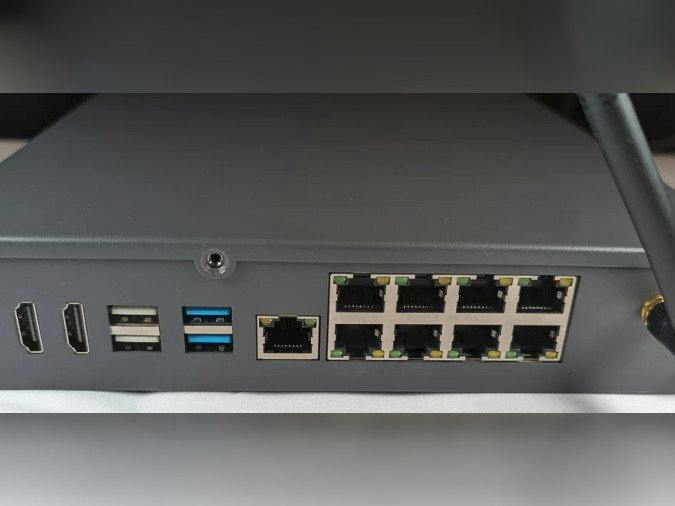
Picture a CCTV setup for a school lab where one board powers eight IP cameras, stores the footage, and runs the recording software. No separate PoE switch, no extra NAS, no tangle of power bricks. That is the pitch behind the Exaviz Cruiser, and its second revision just got a radio upgrade.
What the Cruiser v2 does
The Cruiser is a carrier board for the Raspberry Pi Compute Module 5 (or the CM5 Lite). Drop the module in and the board becomes three things at once: a managed network switch, a storage server for camera footage, and a general Linux box built on the same Broadcom BCM2712 chip found in the Raspberry Pi 5. Exaviz first showed the design in February. Version 2.0 keeps the layout and swaps the wireless section for an Espressif ESP32-C5-MINI-1U module, which brings dual-band Wi-Fi 6 and Bluetooth 6.0 LE in place of the old single-band setup. The 48V input stage was also reworked with better inrush current limiting and protection, which matters when you plug a loaded board into a bench supply.
The numbers that matter
- 8 gigabit PoE+ ports sharing a 120W budget: 15W per port across all eight, or 30W per port across four
- One 2.5GbE uplink to your main network
- Storage: 2 SATA III ports with hardware or software RAID, plus an M.2 M-key slot for NVMe or an accelerator card
- I/O: 3 USB 3.0 ports at 5Gb/s, 4 USB 2.0 ports, 2 independent 4K60 HDMI outputs
- Expansion: 2 Qwiic/STEMMA QT connectors (I2C, so SDA and SCL are already wired) and an optional 8-port add-on module for 16 ports total
- Size and power: 170 x 120mm, single 48V supply
The Qwiic ports are the sleeper feature for makers. You can hang an I2C temperature sensor or a small OLED off the board without touching the GPIO header or soldering anything, then log readings next to the camera feeds. One gotcha: budget your PoE draw before you buy cameras. Eight 15W cameras eat the full 120W, so a PTZ camera pulling 25W means fewer ports in use.
Build it yourself
Pre-orders are open at $159 for the Full variant, about PHP 9,300 before shipping and duties, with the first batch of 100 units due in January. The Cruiser Lite and Keel stay on the v1.0 design for now. You will also need a CM5 module, a 48V PSU sized for your camera load, and an NVMe or SATA drive. For a thesis on campus surveillance, network monitoring, or an edge AI vision system, this replaces three boxes with one. Read the full announcement and spec details on Hackster.io, then start pricing your CM5 and storage.
Frequently Asked Questions
What changed between the Cruiser v1 and v2?
Version 2.0 replaces the single-band wireless with an Espressif ESP32-C5-MINI-1U module for dual-band Wi-Fi 6 and Bluetooth 6.0 LE, and improves the 48V input with better inrush current limiting and protection. The switch, storage, and I/O layout stay the same.
How many PoE cameras can the Cruiser power?
The eight PoE+ ports share a 120W budget, enough for eight devices at 15W each or four at 30W each. An optional expansion module adds eight more gigabit ports, but check your total power draw against the supply before adding high-wattage cameras.
What will I learn if I build a project on this board?
You will practice Linux server setup on the CM5, Power-over-Ethernet budgeting, network switching and VLAN basics, RAID and NVMe storage configuration, and I2C sensor integration through the Qwiic ports. Those skills map directly onto networking, surveillance, and edge-computing thesis topics.
