
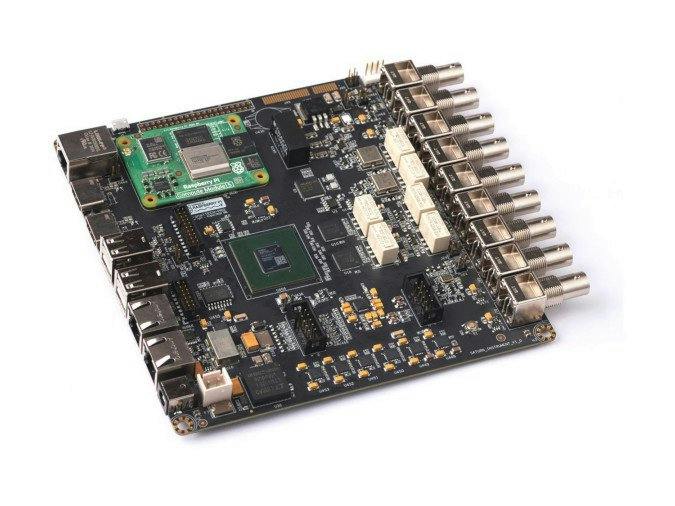
Lab instruments are turning into software. A decade ago an oscilloscope, a spectrum analyzer and a radio transceiver meant three boxes and three price tags. Now the trend is one board with fast converters, an FPGA doing the heavy lifting, and a small Linux computer drawing the screens. SignalTech’s upcoming Saturn boards are one of the clearest examples of that shift we have seen this year, and they run on hardware many of you already know: the Raspberry Pi Compute Module 5.
Two boards, one signal path
The Saturn IE (Instrumentation Edition) and Saturn RE (Radio Edition) share the same core. Two coherent 16-bit ADCs and one 16-bit DAC feed an AMD Artix-7 FPGA, and a CM5 sits on top running standard Debian. On the IE, the path is DC-coupled from connector to converter in both directions, so the board can act as a DC-to-60 MHz oscilloscope, an arbitrary waveform generator, a spectrum analyzer and a time-domain reflectometer for finding cable faults. The RE swaps in an AC-coupled radio front end and becomes an HF-to-6 m amateur transceiver with 3-5 W output and digital predistortion. Neither board needs a host PC; the CM5 handles the apps by itself.
SignalTech plans to launch on Crowd Supply and has promised schematics, FPGA gateware, drivers, a SoapySDR module and a Python package under CERN-OHL-S and GPLv3 before shipping. Hackster has the full announcement here: Saturn IE and RE on Hackster.
The technical takeaway
The clever part is the split of work. The FPGA runs the shared measurement engines at full sample rate, things like filtering, FFTs and lock-in detection, where a CPU would choke. Each instrument is then a thin application on the CM5 that just configures the engine and plots results. That is the same architecture you see in a Red Pitaya or a USRP, and it is worth learning because it scales: fast, fixed math in gateware, flexible UI and logic in Python. For ECE students, this is the gotcha that trips people up in thesis builds. A Pi alone cannot sample a 60 MHz signal through its GPIO pins, no matter how tight your code is. You need dedicated converters and logic in between.
What to try next
- Get an RTL-SDR dongle (around PHP 1,500) and run GQRX or SDR++ on a Pi 5 to learn the receive side.
- Wire an ADS1115 16-bit ADC to a Pi over I2C (SDA on GPIO 2, SCL on GPIO 3) and plot a slow sensor in Python. Same idea, much lower speed.
- Try a cheap iCE40 or Tang Nano FPGA board with open-source Yosys tools before jumping to Artix-7.
Once those pieces click on the breadboard, a board like Saturn stops looking like magic and starts looking like the next project.
Frequently Asked Questions
What is the difference between the Saturn IE and the Saturn RE?
Both use the same CM5, Artix-7 FPGA and 16-bit converters. The IE keeps a DC-coupled path for lab measurements like a DC-to-60 MHz scope and cable testing, while the RE adds an AC-coupled radio front end for HF-to-6 m transmit and receive at 3-5 W.
Do the Saturn boards need a PC to work?
No. The Raspberry Pi Compute Module 5 on board runs Debian and the instrument apps directly, so each board works as a standalone device. SignalTech also plans a SoapySDR module and Python package if you want to script it from your own code.
What will I learn if I build or study a system like this?
You learn how mixed-signal systems split work between hardware and software: ADC and DAC basics, why FPGAs handle high-rate DSP, how a Linux board talks to an FPGA, and how SDR software like SoapySDR exposes radio hardware. These are core topics for ECE communications and embedded systems courses.
