
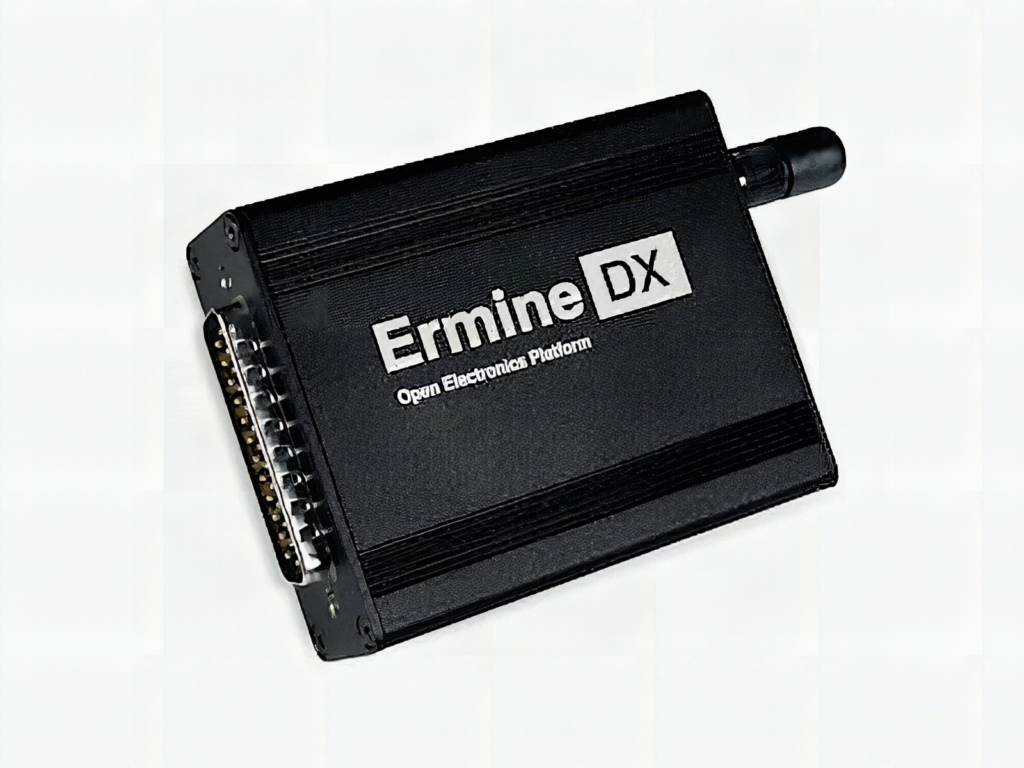
Got a car older than your phone and a free Saturday? The classic garage hack, adding Bluetooth audio to a 1990s stereo or spoofing a CD changer so the head unit stays happy, usually dies at the wiring stage: CAN for newer cars, K-line for old ones, LIN for body-control bits, plus a board tough enough to live under a dashboard through a Manila summer. Ermine, a new ESP32 platform from St11 Digital, packs all of that into one aluminum box.
What they built
Ermine started as two personal projects: a replacement phone system for a 1990s Jaguar and a CD-changer emulator for an early-2000s Volvo. At the center is an ESP32 with 4 MB of flash, Wi-Fi and Bluetooth. Around it sit the interfaces that normally cost you four separate breakout boards: CAN, ISO 9141 K-line, LIN and RS-485, plus general-purpose digital I/O, a microSD slot and a 25-pin D-sub connector on the harness side. The anodized enclosure measures 95 x 63 x 25 mm, and the board accepts either 5 V or a 10 V to 28 V input, with built-in voltage and current monitoring.
The Ermine XK variant has one expansion slot and four high-side MOSFET switches for relays, lights or a pump; the DX trades the switches for a second slot. Plug-in modules add a stereo DAC with mic preamp, a GNSS receiver with a three-axis gyro, or four extra GPIO lines.
Parts and cost reality
The catch: St11 Digital has not announced a price or launch date. It will go through crowdfunding, with schematics and firmware released as open source once production starts. So this weekend you cannot buy one, but you can prototype the same idea on parts you may already own. An ESP32 dev board plus an MCP2515 CAN module with a TJA1050 transceiver gets you talking to an OBD-II port for well under PHP 1,000 combined. CAN-H is pin 6 and CAN-L is pin 14 on the connector, most cars run the diagnostic bus at 500 kbps, and the gotcha that eats most Saturdays is forgetting the 120 ohm termination jumper on the module when you bench-test against a second node. K-line needs a separate L9637-type transceiver, exactly the wiring sprawl Ermine wants to delete.
Firmware is where Ermine saves the most time: an extended MicroPython build plus a self-hosted browser app, Ermine Dash, for editing files, opening a REPL and logging data. If you have used MicroPython on an ESP32 before, the code side will feel familiar.
Spend your Sunday on this
Read the Hackster write-up on Ermine, then wire an ESP32 and MCP2515 to a spare OBD-II connector and sniff the bus on the family car with the ignition on. Log raw CAN frames to a microSD card and try to find the one ID that changes when you press the brake pedal. That afternoon of frame-hunting is the skill Ermine is built around.
Frequently Asked Questions
What interfaces does the Ermine board actually support?
CAN, ISO 9141 K-line, LIN and RS-485 are built in, alongside general-purpose digital I/O, a microSD slot and a 25-pin D-sub connector. It runs from 5 V or a 10 V to 28 V automotive supply and monitors its own voltage and current. The XK variant adds four high-side MOSFET switches; the DX variant adds a second expansion slot.
Can I buy Ermine now, and what does it cost?
Not yet. St11 Digital has not published pricing or a ship date; it will launch through a crowdfunding campaign, with the hardware files and firmware promised as open source when production begins. Until then, an ESP32 dev board with an MCP2515 CAN module covers the CAN-sniffing part of the same experiments.
What will I learn if I build a car-hacking project like this?
You will learn how CAN frames are structured and filtered, how to wire an OBD-II connector safely, how to power a 3.3 V microcontroller from a noisy 12 V vehicle rail, and how to use MicroPython UART and SPI drivers to talk to transceivers. Logging and decoding bus traffic is also a practical introduction to reverse engineering, a skill that carries straight into ECE thesis work on vehicle telemetry.
