
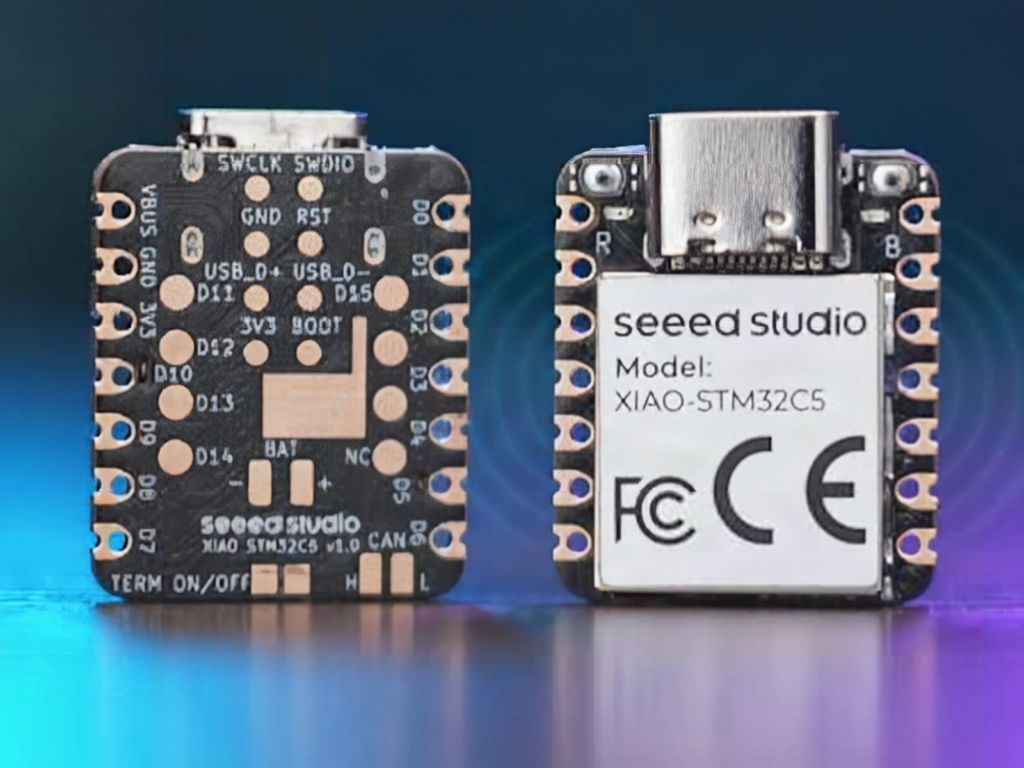
The XIAO footprint started as a thumbnail-sized home for SAMD21 and RP2040 chips, then picked up ESP32 and nRF52 variants. Seeed’s newest addition adds an ST part for the first time, and it points at a bigger shift: tiny boards are moving past hobby blinky demos into industrial buses and sensor-heavy builds that students can finally afford.
The XIAO STM32C5 itself
The board uses an STM32C5A3CG, a single Arm Cortex-M33 core running at up to 144 MHz with floating-point and DSP instructions. You get 256 KB of SRAM, 1 MB of on-chip flash, and a separate 16 MB of external flash for data logging or assets. Seeed lists it at $9.90 with unsoldered pads or $10.90 with headers already soldered, per the Hackster News writeup.
Why CAN FD and a heated IMU matter
Two CAN FD controllers sit on the chip. One connects to an on-board TCAN3403-Q1 transceiver, and the other is free for an external transceiver, so one XIAO can bridge two buses. CAN is the wiring standard in cars and factory machines, and it is also what many competition robots use to link motor controllers. The six-axis IMU has small resistors that warm the sensor before sampling. A stable chip temperature cuts gyro drift, a classic gotcha when a balancing robot slowly walks off course.
What to try next
Software support covers STM32Cube, MicroPython, and Zephyr through PlatformIO, so you can pick the toolchain your class already uses. Start with the Seeed wiki example that reads the IMU over I2C and prints the SDA and SCL traffic on a logic analyzer. Then wire two boards back to back over CAN and send a heartbeat frame at 1 Mbit/s. For a thesis on vehicle or robot networking, that two-node test is a cheap proof of concept. Compare the price against other XIAO boards at Circuit.Rocks before you commit.
Frequently Asked Questions
What microcontroller does the XIAO STM32C5 use?
It uses the STM32C5A3CG, a single Arm Cortex-M33 core at up to 144 MHz with floating-point and DSP support, 256 KB SRAM, 1 MB on-chip flash and 16 MB external flash.
How much does it cost and what can I program it with?
Seeed lists $9.90 without soldered headers and $10.90 with them. It supports STM32Cube, MicroPython, and Zephyr through PlatformIO.
What will I learn if I build this?
You will learn how CAN FD networks link microcontrollers, how a heated IMU reduces drift, and how to move from Arduino-style boards to the STM32 toolchain.
