
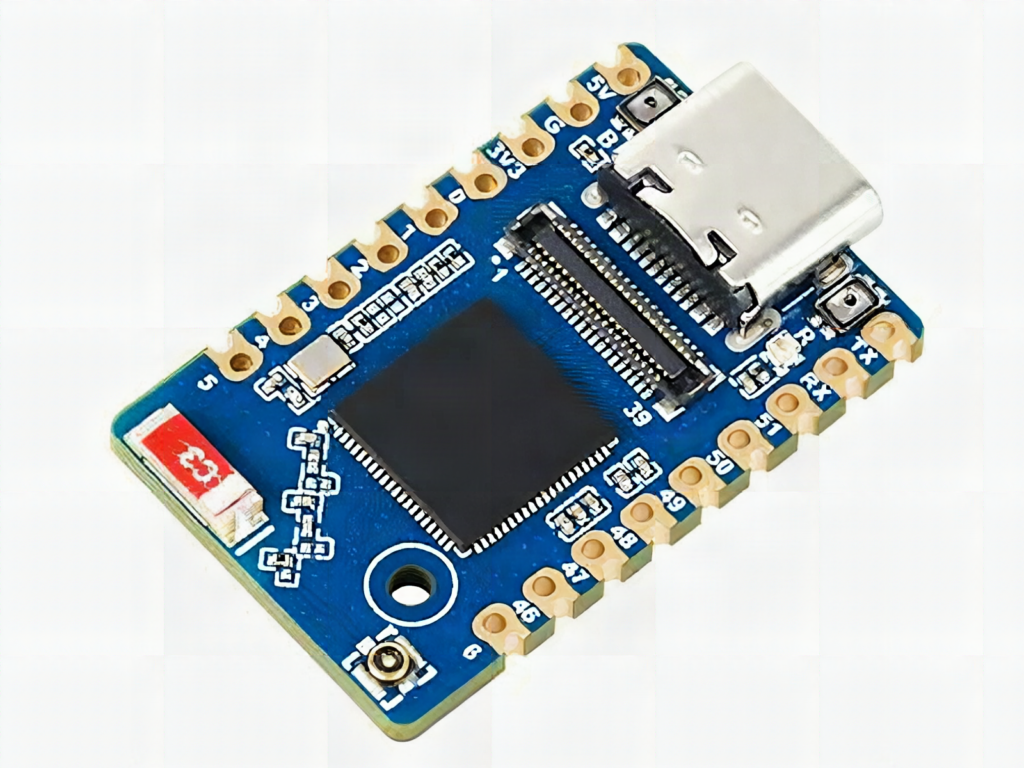
Thumb-sized ESP32 boards usually force a trade: small footprint or enough memory. Waveshare’s ESP32-S31-Zero measures 28×18 mm and still carries up to 32 MB of PSRAM, which is a surprise on a board you can solder flat onto your own PCB.
What Waveshare packed in
The brain is Espressif’s new ESP32-S31: two RISC-V cores at up to 320 MHz, plus a separate low-power core that watches sensors while the big cores sleep. Memory is 512 KB of SRAM, with 16 MB or 32 MB of PSRAM and matching SPI flash depending on the variant. Right now only the 16 MB PSRAM and 32 MB flash version is in stock at $10.99, according to the Hackster News writeup.
Radios, pins and gotchas
Wi-Fi 6 on 2.4 GHz, Bluetooth 5.4 LE, Bluetooth Classic, and IEEE 802.15.4 for Zigbee and Thread all share one chip. A ceramic antenna is onboard, and an IPEX-4 connector takes an external one when your enclosure is metal. Expect 15 exposed GPIO pins on castellated edges, a USB-C port for power and flashing, BOOT and RESET buttons, and a WS2812 LED on a single data line. The tricky part is software: the S31 is still a preview target in ESP-IDF, so some peripheral libraries will lag and examples may need updates.
Build it yourself
Start with the stock Wi-Fi example from Waveshare’s docs and blink the WS2812 to confirm your toolchain. Next, wire an I2C sensor, such as a BME280 on the SDA and SCL pins with 4.7k pull-up resistors if your breakout lacks them, and publish readings over MQTT to a Mosquitto broker on a Raspberry Pi. A 128 KB frame buffer fits easily in that PSRAM, so a small TFT dashboard is the natural second step. For a capstone on classroom air-quality monitoring, one board with Zigbee or Thread can replace two older ones. Browse ESP32 boards at Circuit.Rocks to price a fallback while S31 support matures.
Frequently Asked Questions
What chip does the ESP32-S31-Zero use?
It uses Espressif’s ESP32-S31 with dual RISC-V cores at up to 320 MHz, a low-power core, 512 KB SRAM, and 16 MB or 32 MB of PSRAM depending on the variant.
How much does it cost and is software ready?
The in-stock 16 MB PSRAM, 32 MB flash version sells for $10.99. ESP-IDF treats the S31 as a preview target, so expect some library gaps.
What will I learn if I build this?
You will learn Wi-Fi 6 and Zigbee/Thread networking, I2C sensor wiring, MQTT publishing, and how to work with a preview chip target in ESP-IDF.
