
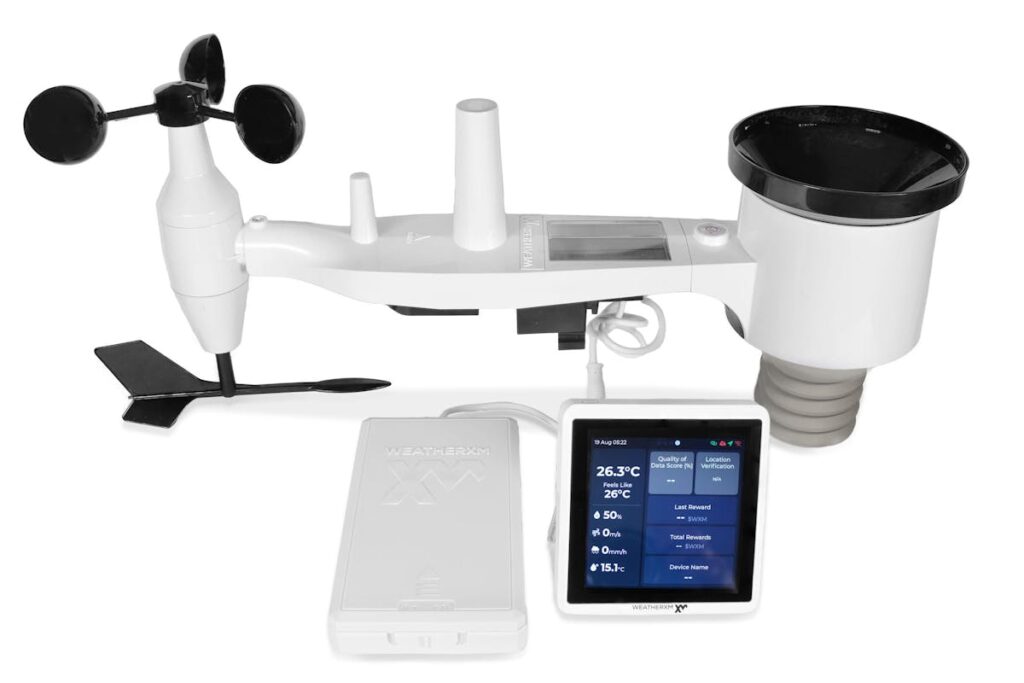
A rain gauge sitting 6 km up a hill has no business needing a Wi-Fi password. That distance kills 2.4 GHz outright, and paying a monthly SIM plan for one sensor is hard to justify. WeatherXM’s new D2 Mesh takes the third road: it hops readings home over a LoRa mesh, running on a small solar panel and nothing else.
What the D2 Mesh actually does
The kit is a complete off-grid station. One unit logs temperature, humidity, barometric pressure, rainfall, wind speed and direction, gusts, light, solar radiation, and UV. An SX1262 transceiver pushes those observations several kilometres with clear line of sight, and multi-hop routing stretches it further. Drop a second solar node on a ridge and you relay past the terrain that blocked the first link.
The other half of the kit is the gateway: an ESP32-S3, its own SX1262 radio, and a 4-inch touchscreen showing live readings. History lands on a microSD card, while local MQTT and REST endpoints hand the data straight to Home Assistant or whatever you self-host. WeatherXM’s cloud stays optional rather than acting as a gate.
What’s inside
The station runs an nRF5340 dual-core MCU with 16 MB of external flash, a u-blox MAX-M10S GNSS receiver for positioning, and a QMI8658A accelerometer and gyro that flags tilt, tampering, or somebody walking off with the mast. Power comes from a 6.5 V, 60 mA panel backed by batteries and a supercapacitor. A single firmware image speaks WeatherXM’s own protocol, Meshtastic, or MeshCore, and the active transport switches at runtime with no reflash. Reporting adapts as well: hourly when conditions sit flat, every 5 minutes once the barometer starts moving.
Build it yourself
You don’t need the kit to copy the idea. A BME280 on I2C (SDA/SCL, plus 4.7 kOhm pull-ups if your breakout leaves them off) and an RFM95 or E22 SX1262 module wired to an ESP32 gets you a working LoRa sensor node on a breadboard. RadioLib drives the radio. A tipping-bucket rain gauge is just a reed switch, so give it one GPIO with an interrupt and debounce it in software rather than adding an RC network. The gotcha most people hit is duty cycle: at SF12 a chatty node blows past regional airtime limits fast, so transmit less often and pack more readings into each packet.
WeatherXM plans to publish schematics, the bill of materials, packet specs, and firmware sources before its Crowd Supply campaign opens. Full details are in the Hackster write-up.
Frequently Asked Questions
How does the D2 Mesh send data without Wi-Fi or a SIM card?
An SX1262 LoRa transceiver carries the readings several kilometres over line of sight, and the mesh can multi-hop through other solar nodes to reach further. A gateway with an ESP32-S3 receives them and exposes local MQTT and REST endpoints, so the data can go to Home Assistant with no cloud account.
What sensors and chips are in the station?
It measures temperature, humidity, barometric pressure, rainfall, wind speed, direction and gusts, light, solar radiation, and UV. Inside sit an nRF5340 dual-core MCU with 16 MB of flash, a u-blox MAX-M10S GNSS receiver, and a QMI8658A accelerometer and gyro for tilt and tamper detection, all fed by a 6.5 V, 60 mA solar panel.
What will I learn if I build this?
Building a scaled-down version teaches I2C sensor wiring with pull-ups, LoRa link budgets and spreading factors, duty-cycle rules that limit how often you can transmit, interrupt handling and debouncing for a reed-switch rain gauge, and solar power budgeting with a supercapacitor buffer. That mix of RF, sensors, and low-power design maps directly onto an ECE thesis or a school environmental monitoring project.
