
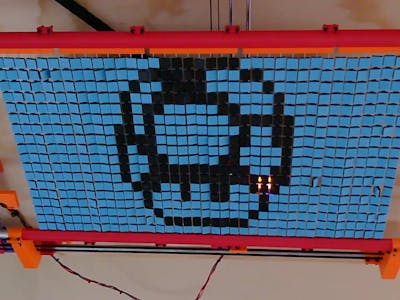
Mechanical displays are having a moment. Flip-disc panels, split-flaps, and solenoid-driven pixel walls keep turning up at maker fairs, mostly because a display you can hear beats one that only glows. They all share one expensive habit, though: every single pixel needs its own actuator. Zimm’s P.A.R. (Pixel Art Robot) throws that assumption out, and the workaround is worth stealing for your own matrix project.
One robot instead of 666 solenoids
A conventional flip-disc pixel pairs a permanent magnet with a solenoid. Pulse the coil one way and the disc shows its light face; reverse the polarity and the dark face comes up. That scales fine for eight pixels. P.A.R. has 666 square discs, which Zimm calls squisks, arranged in a 37 by 18 grid. Built the usual way, that is 666 coils, 666 driver channels, and a power budget nobody wants to size.
So the panel got a gantry instead. A two-axis robot rides behind the display like a pen plotter, driven by an Arduino Nano ESP32. A servo pushes a pin out to prod each squisk and flip it, while a color sensor reads whether that tile is currently light or dark. The robot only touches the squisks that actually need to change, and it can prod a stubborn one twice.
The tradeoff, and why it lands
Refresh time goes from milliseconds to minutes. That would be fatal for a train departure board. For an art piece it is the whole appeal, because you get to watch the image assemble tile by tile. The Nano ESP32 has Wi-Fi on the module, so Zimm put P.A.R. on the internet: a web form takes a drawing from anyone, queues it, and the robot renders it. Past submissions sit in a public gallery.
What to try next
The transferable idea here is closed-loop state sensing. Most matrix builds fire commands blind and trust that the hardware agreed. Reading a pixel back with a color sensor over I2C turns an open-loop guess into something self-correcting, which helps on any actuator array where a missed step is invisible until someone looks at it.
- Start at an 8 by 8 grid, not 666 tiles. One hobby servo on a GPIO pin and a TCS34725-class color sensor is a weekend of gantry math and a defensible capstone demo.
- The Nano ESP32 runs 3.3V logic on its GPIO, so check your servo driver and sensor breakout before wiring SDA and SCL straight across.
- Watch the I2C pull-ups if you chain the color sensor with anything else on the bus. Two breakouts each carrying their own 4.7k resistors will drag the line harder than you planned.
Zimm’s full write-up, including the submission site, is on Hackster: This Flip-Squisk Display Is Nothing Like a Flip-Disc Display.
Frequently Asked Questions
How does P.A.R. flip a tile without a solenoid behind every pixel?
A two-axis gantry robot rides behind the panel like a pen plotter. A servo extends a small pin that physically prods the square tile to flip it, and a color sensor checks whether the tile is currently light or dark so the robot only touches the ones that need changing.
What is the tradeoff compared to a traditional flip-disc display?
Speed. A solenoid panel refreshes in milliseconds; a single robot working across 666 tiles in a 37 by 18 grid takes minutes. That rules it out for a departure board, but for an art piece the slow assembly is part of the appeal, and it replaces hundreds of coils and driver channels with one moving head.
What will I learn if I build this?
Closed-loop control on an actuator array, which is the part most matrix projects skip. You will practice two-axis motion planning and coordinate math, servo timing, I2C sensor reads including pull-up sizing on a shared bus, and 3.3V logic-level checking on the Nano ESP32. Scaling it down to an 8 by 8 grid makes a realistic capstone or thesis demo you can actually finish and defend.
