
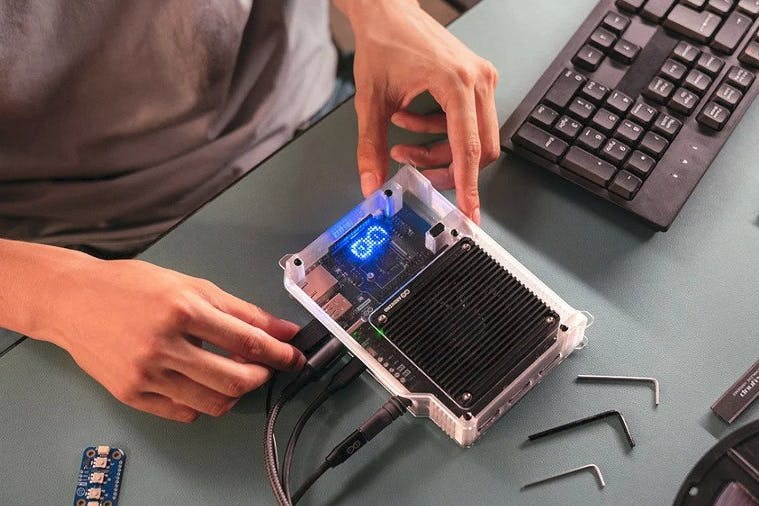
Before you order one, clear some bench space and check your power drawer. The Arduino VENTUNO Q ships with a 65W USB Type-C supply for a reason, and it arrives with a heatsink and an active cooling fan already bolted on. To get something running the day the box lands, have these ready:
- A spare HDMI monitor, or a USB-C cable that carries DisplayPort Alt Mode
- An NVMe SSD for the onboard M.2 slot, if 64GB of eMMC feels tight
- Jumper wires and a breadboard for the GPIO header
- A MIPI camera module if you want to feed the DSP any vision work
What Arduino actually shipped
VENTUNO Q is the second UNO-branded single-board computer, and the name is Italian for twenty-one, marking the project’s 21st year. It abandons the classic UNO footprint for something noticeably bulkier, but it keeps the dual-brain idea introduced on the UNO Q: a Linux-capable application processor sitting beside a real microcontroller, the two talking over a purpose-built bus. Pre-orders are open at $299, with delivery quoted at roughly four weeks.
The silicon underneath
The application side is a Qualcomm Dragonwing IQ-8275, with eight 64-bit Kryo cores clocking up to 2.35GHz, an Adreno 623 GPU, and a Hexagon DSP rated at 40 TOPS for on-device vision and machine learning. Next to it sits an STMicroelectronics STM32H5F5 that handles the deterministic work, which is the half that matters when your capstone demo needs a stepper stepped on time rather than whenever the Linux scheduler gets around to it. Memory is 16GB of LPDDR5; storage is 64GB of eMMC plus that M.2 slot. Radios cover tri-band Wi-Fi 6 and Bluetooth 5.3. The headers expose USB, CAN FD, I2C, I3C, SPI, PWM, UART and plain GPIO, and the board still accepts UNO- and Modulino-format add-ons. Both halves are programmed from Arduino App Lab, which runs on the board itself.
Why the exit path matters more than the specs
For thesis and competition teams, the interesting line in the announcement is not the TOPS figure. Under the Works with Arduino program, SECO and Toradex are offering production-certified SOMs built on the same Dragonwing IQ8 architecture, so an App Lab prototype can move onto a production module without re-architecting the hardware stack. Your models and application logic carry across. That is a rare thing at this price tier, and it is the difference between a project that ends at the defense panel and one that becomes a product. If you want the full spec sheet before committing $299, read the launch writeup on Hackster, then check the Arduino Store listing for regional shipping before you budget the freight.
Frequently Asked Questions
How is the VENTUNO Q different from a Raspberry Pi 5?
The Pi 5 is a single application processor. The VENTUNO Q runs a dual-brain setup: a Qualcomm Dragonwing IQ-8275 for Linux workloads plus a separate STM32H5F5 microcontroller for real-time control, linked over a dedicated bus. That means you get hard timing on motors, sensors and PWM without fighting the Linux scheduler, and a 40 TOPS Hexagon DSP for on-device inference.
What else do I need to buy alongside the $299 board?
Less than you’d think. The 65W USB-C supply and cable are included. Budget for an HDMI or USB-C DisplayPort cable, an NVMe SSD if 64GB of eMMC is tight for your datasets, and a MIPI camera module for vision projects. The GPIO header takes ordinary jumper wires and UNO-format shields, so existing sensors and breakout boards carry over.
What will I learn if I build with a VENTUNO Q?
You’ll practise splitting a system across two processors, which is how most real embedded products are built: perception and networking on the Linux side, deterministic control on the MCU. Along the way you’ll pick up I2C, SPI, CAN FD and UART bring-up, inter-processor messaging, and how to size an edge-AI model against a TOPS budget. Because SECO and Toradex sell production SOMs on the same architecture, the skills transfer directly to industry work.
