
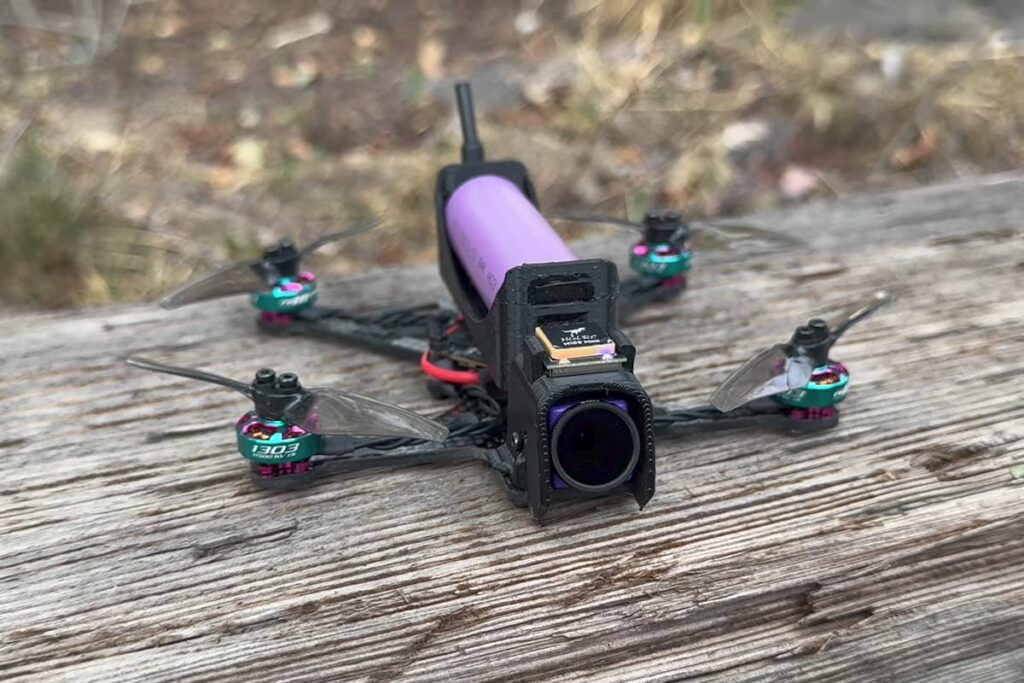
Can a single-cell FPV quadcopter really cover five kilometers and stay airborne for half an hour?
That is the question a builder going by Mediocre Nerd set out to answer with Swift, a 1S long-range quad designed from a blank sheet. Most 1S machines are cheap, feather-light toys that land after four or five minutes because their tiny LiPo packs run out of both capacity and voltage. Swift keeps the 1S simplicity and attacks the endurance problem instead, and the result flew past the 30-minute mark on one test at 34 minutes.
The answer turned out to be wiring, not motors
Swapping the usual flat LiPo for cylindrical lithium-ion cells did most of the work. An 18650 cell gives roughly 20 minutes of cruising; a fatter 21700 pushes the number past 30. But the stock nickel-plated battery contacts were quietly eating volts under load, so the tray was rebuilt with wide copper strips and 18 AWG wire. Measured against BT2.0 and XT30 arrangements, the copper tray showed noticeably less voltage sag, which means more of the stored energy actually reaches the motors instead of warming up a connector.
- Frame: 2.5 mm carbon fiber in a deadcat layout, so the front props stay out of the camera’s view. Home-cut prototypes on thinner sheet kept snapping during crash tests.
- Flight controller: a Flywoo GOKO HD 1S all-in-one with 12A ESCs and an ExpressLRS receiver already on the board, which kills a lot of solder joints and wire weight.
- Motors: 1303 units at 11,500 KV. Earlier 11,000 KV and 15,000 KV attempts felt worse; the bigger stator trades KV for torque and spins the Gemfan Hurricane props more efficiently.
- Video and nav: DJI O4 Lite Air Unit, a GPS module in the canopy, and an ND filter in front of the lens to cut vibration jello.
The finished aircraft is heavier than a typical ultralight 1S quad and still hovers at about 30% throttle. Over open water it held an HD digital feed and GPS telemetry past the five-kilometer mark.
Try the cheap half of this on your bench
You do not need a drone to test the core idea. Grab any 18650 holder, solder a load resistor across it, and probe the cell terminals and the holder tabs with a multimeter while the load is on. The gap between those two readings is the voltage your contacts are stealing. Swap the nickel tab for a strip of copper and 18 AWG wire and measure again. That same trick applies to a battery-powered ESP32 logger or a robot chassis that browns out on motor startup. Full build notes and the flight video are on the Hackster writeup.
Frequently Asked Questions
What gives Swift its 34-minute flight time?
Cylindrical lithium-ion cells instead of the flat LiPo packs normally used on 1S drones. An 18650 cruises for around 20 minutes and a 21700 pushes past 30, with one test run hitting 34. A rebuilt battery tray using copper strips and 18 AWG wire cuts the voltage drop that nickel-plated contacts were adding.
How much of this build has to be custom?
The carbon fiber frame and the battery tray are the custom parts. The electronics are off-the-shelf: a Flywoo GOKO HD 1S all-in-one flight controller with 12A ESCs and ExpressLRS built in, 1303 11,500 KV motors, Gemfan Hurricane props, and a DJI O4 Lite Air Unit for video.
What will I learn if I build this?
Power delivery under load, which is the skill that separates a project that works on the bench from one that works in the field. You practice reading voltage sag with a multimeter, sizing wire gauge to current, soldering motor leads to a flight controller, and choosing a cell chemistry for the discharge curve you actually need. Those transfer straight to battery-powered robots, rovers, and thesis builds.
