
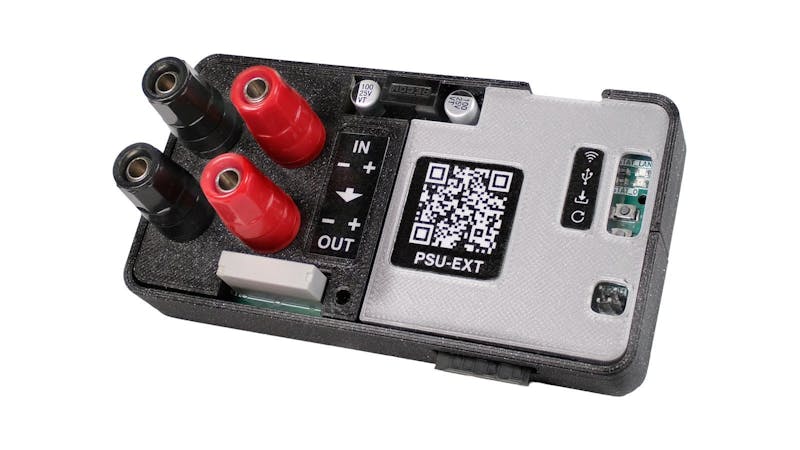
Lab instruments used to be sealed boxes you either bought at full price or did without. That is changing fast. Open source projects keep bolting modern control onto gear that already sits on the bench, and the newest one targets the single most common box in any electronics lab. PSU-EXT, from MaxEELabs, gives a plain manual bench power supply programmable control without anyone cracking its case open.
What the build actually does
PSU-EXT sits inline between the supply and the circuit under test, wired through standard 4 mm banana plugs on both ends. It measures output voltage and current continuously, switches the load through an onboard relay, and serves the whole picture to a browser dashboard with live plots, history charts, protection limits, timers and triggers. Rated range is 0 to 25 V at up to 2.5 A, which covers the cheap variable supplies most ECE labs and thesis groups already own.
The parts doing the work
An ESP32-S3-N16R8 module handles processing and networking. Sensing runs through an INA240A2 current-sense amplifier feeding an ADS1115 ADC, so if you breadboard a test rig around this, your SDA and SCL pull-ups matter as much as the shunt does. The measurement side is isolated from the control side by an ISO1540 digital isolator plus an isolated DC-DC converter, which keeps your laptop off the power path when something on the test bench lets go. The sharpest trick is SCPI over USB CDC and raw TCP on port 5025, the same command language commercial instruments speak, so lab automation scripts talk to it with no custom protocol to write.
What to try next
The practical payoff is watching current instead of guessing at it. Point the dashboard at an ESP32 board during boot and you can see the Wi-Fi radio spike, the flash write, and the drop into deep sleep as separate features on a chart rather than a blur on a three-digit panel meter. PCB design, enclosure, firmware, Gerbers, schematics, the Spring Boot backend and the React frontend are all published, and pricing has not been announced yet. Read the full write-up at Hackster.io, then try the cheap version first: an INA219 breakout on your existing supply rails, logging to serial, before you commit to isolated sensing.
Frequently Asked Questions
How does PSU-EXT control a supply it never opens?
It sits inline through 4 mm banana plugs and switches the output with an onboard relay, so the host supply keeps running in manual mode while PSU-EXT handles enable, protection cutoffs and measurement on the way to your circuit.
What sensing parts does it use, and what are the limits?
An INA240A2 current-sense amplifier feeds an ADS1115 ADC, with an ISO1540 isolator and an isolated DC-DC converter separating the measurement path from the control side. It is rated for 0 to 25 V at up to 2.5 A.
What will I learn if I build this?
Isolated measurement design, I2C sensing with an external ADC, and how SCPI works over USB CDC and TCP port 5025. Those are the same skills used in real test-automation jobs, and a smaller INA219 version makes a solid instrumentation capstone.
